
The cry for liberty and freedom has been heard from oppressed individuals and nations throughout world history and has a spiritual application as well. Before we consider liberty we have to understand that in many ways we are responsible and accountable to others at home, in our places of work and within society as a whole.
It is possible that in the use of our liberty, we end up enslaved by our undisciplined actions as outlined in 2 Peter 2 v 19 and Galatians 5 v 1 The Liberty Bell has its home in Philadelphia, Pennsylvania and is a symbol of freedom and independence in America. It has been rung on many occasions when freedom has been established after hard fought battles, as in the case of the slave trade and the ending of local or world wars.
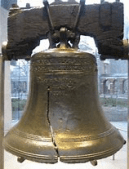 The bell has an inscription on it from Leviticus 25 v 10 that reads “Proclaim Liberty throughout all the land unto all the inhabitants thereof.” As Christians we can say that we are ‘free in Christ’ and at liberty to do ‘All things’ but many may see that as an excuse for God’s grace to forgive all our ‘extra’ transgressions.
Freedom can help control and constrict excessive actions. Constrained actions can offer us greater freedom because it includes a discipline that allows freedom and accountability to reign. Total freedom may result in chaos, yet order with freedom can release us from chaos!
In 1 Corinthians the apostle Paul seeks to offer guidance to the church in respect to divisions and scandals that existed. They included; Incest. (Chapter 5) Complaints brought before a secular court and Fornication. (Chapter 6) Marriage and Virginity. (Chapter 7) Food offered to idols. (Chapter 8 – 10) Decorum in public worship. (Chapter 11)
In 1 Corinthians 6 v 20 the believers are reminded that they have been bought with a price, purchased by the shed blood of Christ and have to honour God in all their ways. From v 12 it reads that everything is permissible but not all things are helpful. So one of life’s greatest dilemmas is how to find and then retain liberty and freedom in the midst of accountability and responsibility?
In Chapters 8 – 10 Paul refers to an early church problem about eating meat that had been offered as a sacrifice to idols. This was deemed unacceptable for a Christian to do and could cause a fellow believer to be discouraged in their faith and practice.
Paul outlined in 1 Corinthians 8 v 6 that there is only one God and idols are not God so they should not be worshipped or be frightened of. In v 9 Paul says that we have a choice to be free and at liberty but it should not act as a stumbling block for others. In 1 Corinthians 9 v 1 and v 19 he declares that he enjoys his liberty and is free from all but is equally happy to be a servant to all for the advancement of the gospel.
1 Corinthians 10 v 23 reads “All things are legitimate (permissible) and we are free to do anything we please; but not all things are helpful.” (profitable, wholesome) So ‘one man’s (persons) meat, (Freedom) is another man’s (persons) poison.’ (Bondage) In v 24 Paul says “Let no one seek their own good (advantage and profit) but seek the welfare and good of their neighbour”
Paul refers to Psalm 24 v 1 and Psalm 50 v 12 in that the whole world is created by the Lord and so is pure, good and wholesome. Then in v 29 he makes the point, do not eat or do anything that might upset a fellow believer which is part of our collective responsibility and accountability to each other.
Such a constraint should not restrict our own personal capacity for freedom and liberty even with the consideration of a fellow believer. This is a real dilemma that pastorally affects each one of us and has to be handled in a wise way that seeks a relational outcome that brings glory to God and is acceptable to fellow believers.
For a moment think about some areas in your life where you have liberty but that freedom might not be helpful, in matters of faith, for those around you? Consider how difficult or easy it is to exercise liberty and freedom whilst showing constraint and accountability?
Paul from v 31, concludes his discussions around the responsibilities we have as Christians and says that: whatever you eat, drink and do, may it always be for the glory of God. Try not to offend anyone both in and outside the church. Look to help all and don’t be anxious for your own advantage but be concerned for the welfare of others as exampled in the life of Paul, from whom his example is Jesus Christ.
So enjoy your liberty and freedom with accountability to others.
Selah (pause to think calmly on what has just been read)
Graham
 Explore to Inspire