
This insight is one of three around the theme of ‘Thin line, sacred space: In church, online and within community.‘ Having considered how ‘thin line and sacred space’ impacts upon the church we can now think about how it acts out online.
Church online
Since the first lockdown there has been an explosion of new online worship opportunities via, YouTube, Zoom and other social media platforms, and then as an addition to in-person worship and fellowship.

In recent months many church fellowships have been able to re-enter their church buildings in person and share together in a different form of worship.
We can wear our Sunday-best mask and sit two metres apart from each other. We cannot sing or fellowship as experienced previously and in a limited form we are able to share Holy Communion.
Alternatively, we can cosy up on the couch in our PJs whilst having our breakfast and choose to engage ‘online church’ via TV, YouTube, PC, tablet or smartphone! In this ‘participation,’ in a measure we control when and where we enter into teaching and worship.
Questions to think about?
One of the questions to consider at this present time is how the relationship between in-church and online activity will exist, in the long and short term? What are the benefits of maintaining both, without burn out for those involved, and how can new team members emerge to enable such ministries to continue if so desired?
Another question we may ask is how we see ourselves: are we merely a spectator and observer online, compared to being a participant and active member when in church?
Worship online may be likened to taking a supplementary feed alongside a richer diet of meeting together in person to pray, worship, fellowship and share in Holy Communion.

The Lord’s presence
In 2 Samuel 7: 1-17 we read about King David enjoying living in the luxury of his palace but was increasingly troubled that the Lord still dwelt in the tent of meeting. The Lord, though, was used to dwelling outside buildings: he was represented by a cloud and a pillar of fire! David was told by the Lord that his son Solomon would build a temple for God’s presence to dwell in.
During Jesus’s ministry he spent lots of time away from traditional places of worship. He travelled along the shore of Tiberius, amongst the crowds and spoke his sermon on ‘the mount.’
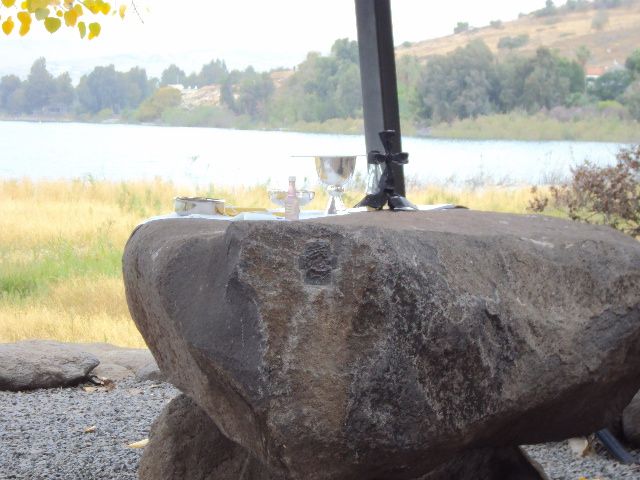
Here is a picture I took which represents a very sacred place traditionally known as ‘Peter’s Primacy.’ It’s at the lakeside of Galilee where Jesus appeared to the disciples after his resurrection.
Many people enquired about Jesus and received healing from him and as an act of worship Palm branches were laid before him on his way into Jerusalem.
In Acts 17: 16 -31 we find the Apostle Paul in Athens debated in the synagogue and around the market area, where all manner of discussions took place, and there was even an alter to an ‘unknown deity.’ We can easily forget that God’s spirit is constantly speaking to people, both in and outside religious places of worship. The Spirit of God will engineer ways so that many are drawn close to him – the promise is that God will draw near to those who seek him. James 4:8
Communication
Years ago, the Scottish publishing company DC Thomson had printed the Scottish Sunday Post and other formal publications. However, there was a concern among the editors that they didn’t appeal to the masses or to a younger generation. So a decision was made to create a more visual format of communication that included pictures and became known as the Comics: the Beano, the Dandy and many others.
Some would say that within a church community the core values and teachings of Jesus can become obscure and only meaningful to a few, through some liturgical structures and language. Once icons and stained glass windows in church buildings sought to convey the gospel message in a simple form that the masses could relate to and understand especially those who could not read. We know that in various ways today the bible has been put into everyday language so that people can understand it.
Fresh expressions
The Lord, by his spirit, is always producing ‘fresh expressions’ of faith so that the simple as well as the learned are able to enter into true worship to God. It’s always important to provide a balanced spiritual diet, that can be supplemented where needed. Online worship has played a meaningful role for everyone in the past year and more, and especially for those not able to attend church for whatever reason. And It also allows enquirers to check in and see what all the ‘noise of faith’ is about!
The life of the early church was different to the worship from the traditional synagogue. Believers met in individual homes, and in the course of time used physical buildings to accommodate and represent a living presence of God.
Within any religious structure there is a tendency for human nature to try and control or ‘contain’ the Lord’s presence. Leaders can enhance inspirational worship or stifle a sense of the presence of God – in church and online. But maybe during Covid 19 the Lord has been speaking to his church in new ways?
Thanksgiving

We are all very grateful to those who have given their time and talents to make sure during this time of lockdown that we have been fed online.
May we remember Hebrews 10:25 exhorting us not to give up meeting together, ‘as some are in the habit of doing.’ It is important not to become spectators and commentators on how the church should be, but to remain participators, humbly coming before the Lord in confession and thanksgiving, to renew our love and loyalty and serve the Lord both in and outside the place of worship.
Today God’s presence can dwell in each believer because of the life and ministry of Christ and the indwelling of the Holy Spirit. As we maintain our private devotions of reading God’s word and applying it to our lives, then in-person and online worship it will aid our desire for a balanced spiritual diet. Both can be a ‘thin line’ and become for us a sacred space.’
Graham
Selah (Pause to think about what you have just read)
 Explore to Inspire