
Family
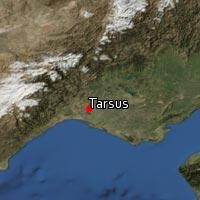
The Apostle Paul lived a very significant and successful life in and around the Mediterranean. He was born into a wealthy Jewish family of Roman citizenship in Tarsus, a centre of great learning. It is not clear if he married or had any children.
However, he did have many church family who were close to him. He called Timothy his “dear son.” (2 Tim 1: 2) Titus his “true son in our common faith.” (Tit 1: 4) Luke ”dear friend.” (Col 4:14) Epaphroditus “my brother, fellow worker and fellow soldier.” (Phil 2: 25) Philemon a “beloved fellow worker.” (Phim.1) He commends his dear sister “Phoebe, a servant of the church in Cenchrea. A great help to many people, including me” (Rom 16:1, 2)
Faith
Paul was a very strict Pharisee with strong orthodox beliefs and was commissioned by the High Priest to arrest Christians in Damascus and ‘cast his vote against them’. He witnessed the stoning of Stephen and was ‘spiritually changed’ through a vision of the risen Christ on route to Damascus. He was befriended by Ananias when blinded and later went on to preach Christ in the city but had to escape a mob by being lowered down the city wall.
Work
Paul spent around three years in Arabia and then returned to Damascus, Tarsus and Jerusalem getting to know Peter and Barnabas. For a period of ten years we know little about his life but he would have been active in Christian service in and around Palestine. Barnabas, one of the early church leaders, asked him to join the team that guided the Gentile church at Antioch. His evangelistic ministry made him one of the most outstanding missionaries of the first century conducting three missionary trips over a twenty year period. His life as a missionary was hard with little monetary help. He worked as a tent maker to pay his own way in the cities where he ministered. (2 Cor 11: 23 – 29)
Travels
He travelled extensively establishing churches with Barnabas and John Mark in Cyprus and central Asia Minor. He had a strong disagreement with Peter in Antioch concerning how far the Gentiles had to accept Jewish teaching and practice. The question was settled at the Council of Jerusalem where ‘salvation’ was considered a matter of faith not works so that Gentile believers were no longer under Jewish obligations. (Acts 15).
Paul travelled with Silas throughout Asia Minor, Macedonian, Corinth and Ephesus. He also worked with Timothy and Titus who often represented him in local churches and even collected money for the poor Christians in Jerusalem. There he was seized by a Jewish mob only to be saved by a Roman garrison and kept in custody at Caesarea for two years by the Roman governor Felix. His successor Festus, suggested that Paul be tried at Jerusalem but Paul felt justice would be better served by appealing to Emperor Caesar and taken to Rome, surviving a shipwreck at Malta on the way.
After two years in Rome he was probably released and engaged in further missionary work before returning to Rome and tradition believes that he was martyred during Nero’s persecution AD 64, and his tomb has been associated with the Basilica in Rome.
Writings
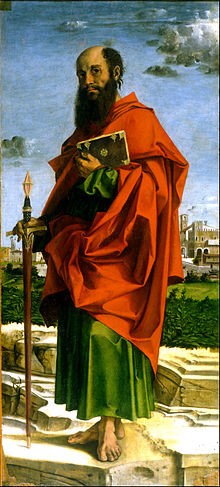
The book of Acts contains many accounts of Paul’s travels and influences. The primary source for historical information about Paul can be found in the thirteen/fourteen letters traditionally attributed to him and were written to the churches he attended and offered a full understanding of Christian belief and how it should be lived within the church and society.
Seven are clearly understood to be written by Paul – Romans, 1 & 2 Corinthians, Galatians, Philippians, 1 Thessalonians, and Philemon. In regards to the remainder – Ephesians, Colossians, 1 & 2 Timothy, Titus, 2 Thessalonians and Hebrews some questions are raised about his authorship.
Character
Paul is described as quite unremarkable. A man of small statue, with a bald head and crooked legs, his eyebrows meeting and his nose somewhat crooked.’ He sometimes appears like an ordinary man and on other occasions had a face of an angel. Critics called his writing weighty and forceful, but in person he was unimpressive and his speaking amounted to nothing.’ (2 Cor 10: 10)
Many described him as a narrow, chauvinistic zealot more concerned with theology than people. Yet such an image is far from the truth. His abrasiveness was due in part to his cultural characteristics which also included a tender and loving side when dealing with the churches and often asked to be remembered to many of the women he had met.
Through his effective missionary endeavours, that included various teams to cities that were hubs of the Roman Empire, he enabled the early church to grow and its faith to penetrate multiple levels of first century society. He visited the Jews in the synagogues first and then to the Gentiles. He planted further churches and often revisited them for further teaching and encouragement.
Theologian
Paul helped to bring together Jewish and Gentile views of how to follow Jesus in an established church. He had an exalted view of Christ that dominated his Epistles. He described Jesus, as God made flesh and the resurrected Jesus as Lord of the universe and Christ can provide power for righteous living to those who have faith in him.
This man, like all of us, had his faults but was a warm and very human man. He was loved and chastened by many and modelled his life on Jesus in practical and theological ways. He was faithful to his calling to Christ and lived a sacrificial life at great personal cost to teach, support and care for those in and outside the church.
Think about your own ‘successes and significance.’ If you’re not sure, ask your family and friends?
Welcome to the ‘significant and successful’ life of Saint Paul the Apostle.
 Explore to Inspire