
Bible base – Acts 12: 25 – 16: 5
In our previous study we outlined the life of Saint Paul, from persecutor of Christians, his dramatic conversion of faith, to a passionate promoter of the Way. Paul then entered into a quiet period of preparation and isolation that strengthened his faith to be shared with the world of his day.
In our next three studies we will consider the journeys of Paul and those he met and worked with, also the places he visited and his aims, ambitions and reactions he experienced.
Alongside our review of Paul’s travels we can consider four seasons in life that may reflect in some way our own journey of faith. 1) Our formative years. 2) Emerging adult years from 15 – 30. 3) The challenge and joy of midlife from 30 – 55 years. 4) A time of maturity and preparation for being with our Lord from 55 – 80 plus years.
Team members
Barnabus, Saul and Barnabas’s cousin John Mark gathered together in the church at Antioch with three other gifted people Simeon, Lucius, Manaen.
As they worshipped and prayed to the Lord, the Holy Spirit told Barnabus and Saul to be ‘set apart.’ The people prayed and commissioned them to embark on their first missionary trip.
Travel
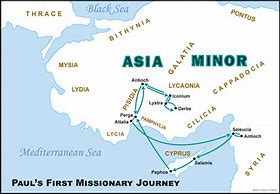
The group sailed to Cyprus from Seleucia and visited the local synagogues to share the ‘word of God’ with John assisting them. At one point (chapter 14) Paul was confronted by a magician called Bar Jesus who violently opposed him. Paul prayed for him and he became blind for a time. During this encounter a witnessing proconsul observed andbelieved! At this point Saul’s name significantly changed to Paul and was filled with the Holy Spirt. They continued their travels from Paphos to Perga in Pamphylia where John, for his own reason, returned to Jerusalem. They entered another synagogue at Pisidia Antioch which was a Roman colony in Galatia, which was part of their strategic planning.
Aim and Actions
In the synagogue Paul addressed the ‘Men of Israel’ and offered a history lesson from Moses to David and then outlined the life and ministry of Jesus as the promised Messiah. Paul always went to the community of Jews first and then to the Gentiles. After the next Sabbath a number of Jews disputed Paul’s teaching which emphasised that the Jews were to be a light to all the nations but had failed. Paul and Barnabas had to leave that place and continued to Iconium (Chapter 14) where they spoke for a while before having to flee to Lystra and Derbe
Reactions
At Lystra the miracle of the lame man took place who was able to walk again. People witnessing such actions thought that ‘the gods had come down upon us in the likeness of men.’ Barnabas was likened to Zeus and Paul to Hermes.
The message of Paul and Barnabas did not go down well with a number of people and various disputes arose. Equally, lots of people believed and witnessed ‘signs and wonders.’ Then the Jews from Antioch and Iconium began to stone Paul to the point where he was considered to have died.
During this mission trip they strengthened the ‘souls of the disciples’ (14:22) and recognised that persecution went hand in hand with sharing the message of Jesus. After a time of praying and fasting Paul appointed elders in the churches he had formed to offer leadership and pastoral support.
The mission trip was completed by travelling to Pisidia, Perga, Attalia and then a return to Antioch. They gave thanks for all that God had achieved and how a ‘door of faith’ had opened up to all the Gentiles.
Having been chased and hassled by many on their trip they returned to Jerusalem to face the brethren who demanded that all new Gentiles believers had to embrace the Jewish laws to be fully accepted. This led to the Council of Jerusalem in chapter 15 where the matter was resolved with the wise leadership and council from James. Paul and Barnabas continued to share about all the amazing signs and wonders that had taken place.
Unfortunately in agreeing to revisit the churches Paul and Barnabas disagreed about who would travel in the team. This meant that Barnabas and Mark went to Cyprus and Paul and Silas, a member of the Jerusalem church and a Roman citizen, revisited the churches in Asia Minor. It was there that they met Timothy, who Paul took with him, and shared the outcome of the council of Jerusalem.
Questions to consider.
Think about your formative years growing up in your own family. Has it helped you in a life of faith or hindered you?
- As we emerged into adulthood from 15 – 30, how did those we met and lived with affect our life of faith? In all your relationships, aims and directions, how much have you felt the presence and guidance of the Lord?
- What experiences have you had of a mission trip near or far?
- What is it like having to work as a team in a church/Christian context and how do we resolve differences of opinion?
- Can you recall any ‘signs and wonders’ that you witnessed as an individual and in the context of church and community life?
- What ‘significances and successes’ have emerged from your mission/church involvements?
 Explore to Inspire