
In our three studies we will consider the journeys of Paul and those he met and worked with. Some of the places he visited and his ambitions and reactions he experienced. Alongside a review of Paul’s travels we can consider four seasons in life that may reflect in some way our own journey of faith. 1) Our formative years. 2) Emerging adult years from 15 – 30. 3) The challenge and joy of midlife from 30 – 55 years. 4) A time of maturity and preparation for being with our Lord from 55 – 80 plus years.
In this study we will continue to focus on some of the people Paul met and ministered to and think about some of our own ‘challenges and joys of midlife from 30 – 55 years.’
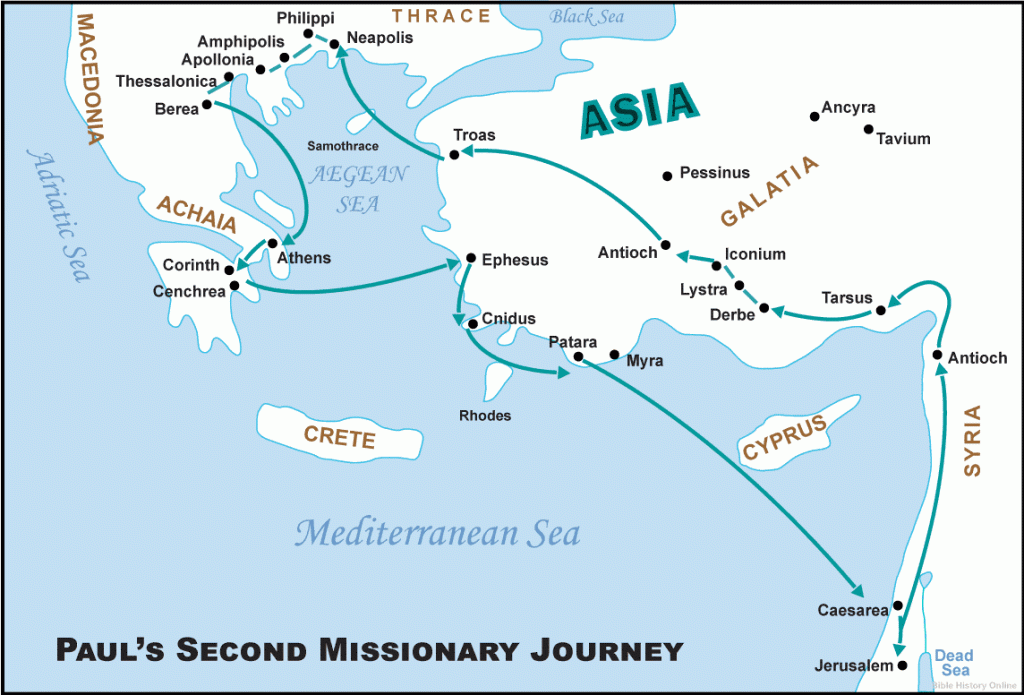
In Paul’s second journey he revisited and strengthened the churches in Syria, Cilicia, Phrygia and Galatia. He was accompanied by Silas and Timothy and it lasted for about three years. There was one critical moment when Paul met, in a vision, a man of Macedonia at Troas asking Paul to visit and help them. This experience changed everything and determined the team’s future plans and travels.
The group then travelled to Neaolis, Philippi, Thessalonica and then Beroea. Paul spent some time in Athens and around eighteen months in Corinth. He concluded his second journey by visiting Ephesus, Jerusalem and finally returning to where he started in Antioch. In this adventure Paul crossed from Asia Minor to Europe meeting many individuals and experiencing some frightening situations. There were countless people who were very grateful for his teaching, pastoral support and guidance.
At this point I would like to introduce to you some of the individuals Paul encountered.
Lydia in Philippi(Acts 16: 11 – 15)
Philippi was a Roman colony and Paul spoke on the Sabbath at a nearby river. There the team meet Lydia a merchant of purple who believed and is recognised as the first European convert.
The disturbed slave girl (Acts 16: 16 – 24)
As a contrast to the high standing of Lydia here Paul and the team meet with a slave-girl, a Pytho, who was mentally disturbed and used as a fortune teller. Paul prayed for God’s healing for the woman and in her healing she gave up the fortune telling which did not please her master. This lead to Paul and Silas being arrested and imprisoned.
The Philippian jailer (Acts 16: 25 – 40)
The Roman jailer represented in his day a middle section of society. Philippi was in an area where earthquakes often occurred. During the night as Paul and Silas were worshipping the gates opened and after his initial fear the jailer accepted Christ as his saviour which was to benefit all his household.
Jason in Thessalonica (Acts 17: 1 – 9)
Thessalonica was a very busy city and the team spoke to many male and female Jews and Greeks who were attached to the local synagogues. However, certain Jews became very hostile and accused Jason and his friends of causing political unrest and presented them before the local magistrates. This action drove the team out of town and on towards Beroea sixty miles away.
Worshippers in the synagogue at Beroea. (Acts 17: 10 – 15)
Here many gathered together to study the scriptures and worship the Lord. Sadly many more rose up to oppose Paul, thinking they were doing God’s will in defending their faith. Paul showed great courage in surviving prison and the mob in Thessalonica but once again had to flee Beroea.
Philosophers at Athens (Acts 17: 16 – 34)
Here in Athens Paul continued to teach and preach and engaged with philosophers at the Areopagus where they worshipped the ‘unknown god.’ Paul had three main reactions to his teaching about the resurrected Jesus. 1) Those who mocked. 2) Those who deliberated to another day. 3) Those who believed such as Dionysius an intellectual male and Damaris an ordinary lady.
Gallio in Corinth. (Acts 18: 1 – 17)
Corinth was a very busy and worldly Greek city. As Jewish custom would have it, Paul worked as a tent maker whilst he preached which kept him connected to ordinary working people as well as others of high status. In his letters he addressed certain moral and spiritual issues that existed in and outside the church and how they should be relational and spiritual in a worshipping community. Some Jews continued to oppose Paul who found sympathy and kindness under the governance of Gallio.
Pricilla and Aquila travelled to Antioch (Acts 18: 18 – 23)
Paul stayed with Aquila and Pricilla who shared his craft of tentmaking. The Jewish couple offered hospitality to many with Pricilla considered a lady of Roman citizenship. Both were an encouragement to Paul and the team in continuing their demanding ministry and travelled back to Antioch with them.
Questions to consider
- Look back during your mid-years and think of the people who greatly influenced you? How did they affect your life of faith and general living?
- Consider for a moment some of those ‘cross-road experiences’ when you did not know exactly what to do and where to go? Did you met a man or woman of Macedonia who guided you?
- As a believer in Jesus, do you feel inferior in the company of those outside your class structure and those who are from a difference race, creed or gender?
- How do you negotiate opposition that comes your way at home, work, church and in community?
- Can you recall any unexpected acts of sympathy and kindness that has changed your life situation as seen in Gallio the proconsul?
- We often think about Barnabas being a person of encouragement. What can we learn from the example of Aquila and Pricilla’s ministry of encouragement and hospitality?
 Explore to Inspire