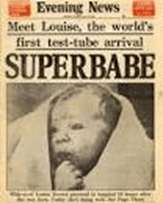
Those of us who are old enough to remember the birth of the first human being by in vitro fertilisation (IVF) – Louise Brown from Oldham born in July 1978 – cannot forget the joy and happiness brought to the parents of this “little miracle”, nor can we forget the hope and pleasure the invention has brought to thousands of people around the world who can now overcome infertility problems because of it.
No-one who has not experienced infertility can truly understand the heart-break, deep sorrow and distress which the inability to have children can bring to people whose only wish is to have a family of their own.
IVF and sperm donation has now become a big business around the world. Thankfully most of it is regulated and proper agencies exist to control and monitor what can be a very traumatic experience for the people involved in the transaction.
Some egg and sperm donors do so purely for altruistic rather than financial reasons although, as in many areas of life, some people do it for completely the wrong reasons. I understand some people also use “DIY” methods of conception and it’s even possible, if you’re wealthy enough, for clinics (mostly in America) to genetically make “designer babies” with the choice of gender, eye and hair colour. The mind boggles!
It’s already being recognised that some people created from external forms of fertilisation are now meeting up and forming loving relationships which could lead to genetic and other problems if children were born as a result of their union. It can also happen within families where there are very close blood ties or in small communities where “new blood” isn’t being introduced.
There are innumerable ethical, moral, and other considerations involved in the IVF process, not least of which is also the religious aspect of creating life. Arguably, in addition to these different conundrums, there is the cost of IVF and other fertility options now available. Should the NHS money be better used for life-saving treatments rather than life-enhancing work?
Graham – I daresay this dilemma has caused much discussion and dispute within the traditional Christian hierarchy over the years, even though it is a fairly normal part of life these days.
What I’d like to know is what would God’s view be of the fact that science and medical professionals are manipulating nature and creating life when this has been His domain in the past?
Should we be “messing” with nature or do you think God gave these professionals the gift and power to create life?
Rev Graham replies:
In responding to your question, Carol, I think it is important to firstly consider what God would have to say in respect to the purpose of marriage. Then we may consider the practises of IVF (in vitro fertilization) and AID (artificial insemination donor) and how they relate to the intentions God has for marriage and procreation.
Secondly, for those who do not believe in a God or have any allegiance to the institution of marriage, they will have few objections to the opportunities that science and technology offers to those who are unable to have children naturally. Thirdly, we will find that some views accept that any developments in the field of medicine is a gift from God and it is up to communities of faith and no faith to work out what is the best way to uphold their own ethical and moral positions while enabling those seeking to have a child are supported and helped.
Covenantal Marriage

Marriage as understood from the Bible and within Jewish and Christian traditions represent God’s covenantal institution of how two people decide to commit to each other in love and devotion and is seen as a sacrament before God and within the Christian community.
Two individuals getting married will have decided to ‘tie the knot’ with an intention, where able and desiring, to have children of their own so as to populate and maintain the future growth and life of human society. Thank you Hien Nguyen pexels.com
God has a particular intention of marriage to form as a bedrock of a loving and orderly society. Marriage in a modern world, where individuality seems to reign, is quite counter cultural and something that should always be seen as of worth before God and within society and without it society and children are a lot poorer.
Ethical Debate
At this point it may be helpful to understanding how Bioethics relates to the interface between morality and ethics and the advances which have taken place within technology and society. Many Christians believe that any proactive scientific developments are only efforts to usurp the sovereignty of God in deciding who and when a baby may be born and live.
Research in embryology, obstetrics and medicine have developed procedures which alter or replicate altogether human fertilization by heterosexual intercourse and initial gestation in vitro as expressed in the following:
1) Artificial insemination by husband (AID) or a sperm donor (AID)
2) In vitro (outside the human body) fertilization (IVF) using the sperm of a husband or donor or egg of the wife or surrogate mother.
Such procedures and possibilities have challenged contemporary Christian and Religious ethics.
Some of the key areas for debate concern the introduction of a third party to a marriage which mainly consists of two people. There is also the possibility that certain risks exist to the welfare of any offspring and a displacement of traditional methods of conception and childbearing which results in a new morality. It is a fact that today in our modern world many children are born as a result of AID and IVF.
There continues to be great debate concerning AID and IVF within the Roman Catholic, Protestant, Jewish and other faith communities. The unity of God seen as the creator is a foundational basis for all actions and goals in respect to sexuality. Any process which exists without the unity of a creator God can alienate people from God as a creator and giver of life. The act of marital love which conceives can be seen to be separate from any help gained via AID. Such assistance may be viewed as being potentially harmful to offspring and the family compared with an exclusive use of sperm which emanates from a loving relationship between a man and a woman.
Paul Ramsey, a Protestant Ethicist (New Dictionary of Christian Ethics IVP p536), sees sexuality and procreation as existing in the sole context of the marital bond which remains faithful to a union with God as creator and is seen as a unity of love and creation. An alternative view would be that AID and IVF help solve deep problems which couples experience and thereby strengthens the unity of a family to grow and any offspring to embrace life. Some people have and do feel that AID may encourage adultery and those who are donors are part of a so called stud farm for humans.
Richard McCormack, a Roman Catholic moral theologian (New Dictionary of Christian Ethics IVP p536), feels that AID is disruptive to the loving actions of a married couple in their sexual expression and parenthood.
Muddy Waters
Some of the challenges we have considered may reflect how people want to be unfettered from all moral ethics and any religious constraints so that they are able to embrace and enjoy the benefits of modern science and technology.

However, in continuing to answer your question, Carol, not all forms of fertility and infertility are opposed. Adoption can be seen as an alternative for couples but not as desirable. In the Jewish practice of Levirate marriage as found in Deuteronomy 25: 5-6 family help may discount the anonymity of a donor or third party involved in a sexual relationship. Thank you Rodrigo pexels.com
Many support AID as morally acceptable in which it acts as an exception for fertilization of a desired child as long as consent from the husband, recipient and the donor is agreed.
A Person and Individual – Not a Product or Service
Genesis 4: 1 and Psalm 100: 3 affirm that God is involved in parenthood and couples have to be careful when trying to give God a helping hand as witnessed in the life of Abram and Sarah as found in Genesis 16. Any new life developed from the science lab that is seen and treated as a product, over a person with their own ethical viewpoint, is contrary to how the Bible would view things.
Within the teachings of the Roman Catholic Church, many modern ethical developments should be anchored within the doctrine of ‘Natural Law’. When a man and woman come together and engage in sexual intercourse, there has to be a reality for both that pregnancy may occur and they become parents of a new-born child. On that basis it can be argued that to prevent pregnancies to occur in the form of any contraception is against ‘Natural Law’ and is wrong.
Alongside such a view is that, if fertility does not naturally take place, then there should be no use of technology in the form of artificial insemination (AID) or in vitro fertilization (IVF). There is also a view around ‘Stewardship’ in that God gives men and women the responsibility for managing all of creation and its resources as recorded in Genesis 1: 28 and are required ‘to be fruitful and multiply/increase in number’.
An alternative understanding to the above is that God’s ‘permissive will’ encourages married couples to procreate. As such it may be claimed that any advances in medical science, in one form or another, may enable couples to become fertile who have been struggling or unable to have a child naturally.
Secondly, the use of any contraception can be viewed also as a technological gift from God so that couples are able to limit the number of children born in a world which is increasingly crowded and not so welcoming and supportive for a child to flourish and blossom in. As in so many difficult and opposing ethical dilemmas, it is vital for individuals and couples to seek a wisdom and guidance from God as to how they will resist any technological gifts or to use them in a wise and Godly manner.
The Value and Dignity of Life
Overall, the basis for Christian teaching and ethical standards and morals is to maintain a value and dignity for all individuals who are created from God, who loves and cares for all his creation. People are not to be seen as commodities to be used and abused for human advancement and any abuse of power and responsibility.
A wider topic in that sense is where the use of surrogacies takes place by a male or female and any embryo experimentation. It is natural for most people to aspire to being a parent but, if nature or even human intervention does not allow, then there has to come a time for acceptance of a given reality and not pursue further a goal at any cost and by any means.
To use a third party in producing a child may, in the short and long term, reduce the value of that person to one of being a product and means and being classified as a sperminator or wombleaser. Also, to use embryos for experimental use unchecked and monitored will reduce their importance, value and meaning even in a pursuit of another person’s happiness.
When thinking about resources, Carol, and the cost of AID and IVF to the National Health Service, I think in recent years that support has been increasingly transferred to life-saving treatment and people have to self-fund any processes at a considerable cost. Ultimately, ethicists, politicians, religious leaders and the view of popular opinion will influence further debate and any more restrictions or new resources to be made available as seen fit for individuals, couples and society in general.
Last month (August 2023) it was reported in the media that only 600,000 babies were born in the United Kingdom in recent years which makes it the lowest birth rate since the 1970’s. The intervention of contraception will have contributed to that low birth rate in a good sense, reducing burdens on large families, but equally it has restricted any God-given opportunities for an increase and maintenance of populations that are cared for when growing up and in turn will be asked to care for their older generation when the time comes.
Many more couples are choosing lifestyle over having a family and, if later in life they want to start a family, they can often have trouble in conceiving naturally. As always with any science and technology, it brings with it new opportunities and choices but also creates other problems which are not foreseen.
References from New Dictionary of Christian Ethics IVP and – New Dictionary of Theology SCM Press
Previous Questions
 Explore to Inspire