
I don’t know if you have studied and thought a lot about the life, tradition and legacy of Joseph of Arimathea throughout the Christian world and beyond? Just for a moment may we consider his life, tradition and legacy that has surrounded him?
Actual Life

The only factual information we have about Joseph of Arimathea was that he was a rich man and a disciple of Jesus. He approached Pilate asking for the body of Jesus and he was granted his request. Jesus was placed in a tomb and a stone was rolled in front of the entrance as found in: Matthew 27 v 57 – 61: Thank you Martunus805 Freepiks.com
Joseph was a member of the ruling Council and was waiting and looking for the kingdom of God to appear on earth (Mark 15 v 42 – 47). Joseph ‘had not consented to the council’s decision and actions’ and together with Nicodemus they prepared Jesus’ body for burial with reverence and godly fear (Luke 23 v 50 – 56). They took Jesus’s body and laid it in a tomb that hadn’t been used and was set aside and intended for Joseph.
Tradition and Reputation
Tradition says that Joseph was a distant relative of the family of Jesus and that he made his wealth from tin mines in Cornwall in the United Kingdom. It is believed that Joseph would have visited the mines from time to time and within such tradition one visit included Jesus when he was allegedly a teenager. It is believed that on one such visit by Joseph it inspired the writing of the poem and later hymn Jerusalem written by William Blake (1757 – 18 27)
“And did those feet in ancient time, walk upon England’s mountains green? And was the holy Lamb of God, on England’s pleasant pastures seen? And did the countenance divine, shine forth upon our clouded hills? And was Jerusalem builded here, among those dark satanic mills?”
“Bring me my bow of burning gold! Bring me my arrows of desire! Bring me my spear! O clouds, unfold! Bring me my chariot of fire! I will not cease from mental fight, nor shall my sword sleep in my hand, till we have built Jerusalem in England’s green and pleasant land”.
After the crucifixion of Jesus it is said that Joseph returned to Cornwall and brought with him a ‘chalice used at the Last Supper’ which became known as the Holy Grail and found its way to Glastonbury. When Joseph arrived at Glastonbury he planted his staff which took root and blossomed into a thorn tree. The Grail had been hidden and became part of a great tradition (“the matter of Britain”) and revealed itself in the unsuccessful quest of the knights of King Arthur to find the Grail.
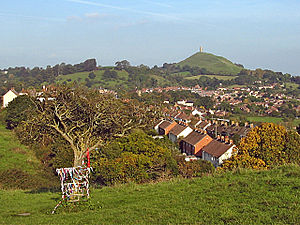
The thorn tree remained at Glastonbury and is said to have flowered each year on Christmas day. One of Cromwell‘s soldiers is said to have cut the tree down because of it being ‘a relic of superstition.’ However, as the tree fell one of its thorns is said to have blinded the axe man in one eye.
Tradition remains that a cutting from the original thorn tree survived in Glastonbury and trees propagated from it can be found in Washington DC and elsewhere? It is said that leaves from the original thorn tree are sold in the tourist shops in Glastonbury?
Has this Glastonbury legend any merit at all in history we may ask?
- Tin, which is an essential ingredient of bronze, was in great demand and highly valued with many Phoenician ships importing tin from Cornwall. It may be safe to say that during the first century investors who owned shares in the Cornwall tin industry would possibly have included some Jewish Christians.
- Christianity took root in Britain quite quickly through, amongst others, a wealthy Jewish Christian connected to the tin trade. It can be argued that the man’s name had been forgotten and therefore believers sought to consult the scriptures to see if there was any wealthy Jewish converts and two could be found which included Joseph and Barnabas. Tradition therefore, has grown around the possibility that the wealthy convert was Joseph rather than Barnabas.
Tradition can be misleading and confusing. It can detract from the main issue or point being passed on! However, tradition can help make and sustain a point of truth that has been found in scripture which can be applied in the case of Joseph and considered in the following points:
Joseph’ life and legacy
Wealth
Even though Joseph was wealthy, in Christian and religious traditions, it can be considered impossible or difficult for rich people to enter the kingdom of God (Matthew 19 v 23- 24), However, Joseph used his wealth and position for the benefit of Jesus and it can be used for the help of the wider community overall.
Secret believer
When I think of Joseph and Nicodemus it reminds me of how the persecuted church down the ages has lived and worshipped. Joseph was a secret disciple of Jesus and was accompanied by Nicodemus, also a secret believer, who visited Jesus during the night when it was dark.
Joseph could have possibly experienced difficulties in his place of work and feared for his reputation and may have been in danger for his life. Joseph and Nicodemus held a secret faith rather than being seen as public believers. However, they shared a commonality and cared for Jesus’ body according to the Jewish custom of the day as recorded in John 19 v 38 – 42.
Provider
Joseph was generous in offering up his own tomb for Jesus and at the time he would not have known that Jesus’ body was not going to be staying there for long! His action could have incurred quite an expense for him in having to purchase another tomb for himself or maybe comforted in the knowledge that when he died he would be laid alongside Jesus in the existing tomb.
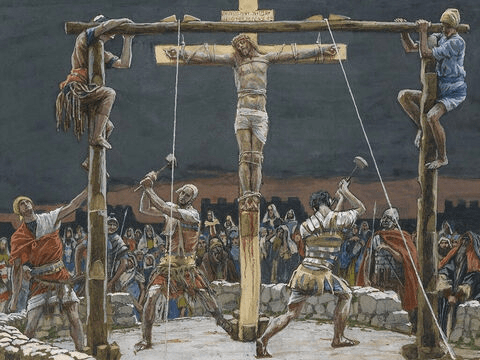
Thank you freebibleimages.org
It is not an easy thing to take the responsibility of caring and preparing for a dead body! Together Joseph and Nicodemus practiced proper custom and procedure in preparing Jesus’ body that included costly spices and linen, as well as the tomb.
Joseph in his character showed immense kindness and compassion, he was a ‘good and upright man’ and not many of his contemporaries would not have been able or willing to do what he did.
Even those who professionally care for the dying and deceased, irrespective of the wages they would get from doing the job, have to be kind, compassionate and show a caring spirit.
Trouble
When faced with persecution and the loss of a loved one, none of us know exactly how we may act in such situations. We may plan and prepare to react in a particular manner but so often it is the unexpected people who quite naturally respond to a need in times of crisis.
Those who we expect to do well are often the ones who may surprisingly struggle and do not respond in the way they anticipated. They can ‘freeze’ emotionally and thereby not complete what they anticipated to do on ‘a day or an hour.’ Joseph in his own way was ‘waiting and preparing for the coming of God’s kingdom.’ The actions and reactions we take in life do reflect the state of our hearts towards God and our neighbours and friends. Joseph endured his own difficulties and leaves us a very good example to follow.
Surprises of God
In Matthew 25 v 31 – 46 we read of the parable of the ‘Sheep and Goats’. The lesson to learn from Joseph and the parable is that ‘whatever we do for one of the least of the brothers of mine, you did for me v 40.’ Our faith may show itself outwardly or in a quiet manner but either way it has to be real and of substance that supersedes our own life situations
Personal Legacy
Whatever we may have done in our own lives, it can be enhanced, lost or confused. People will assess and use our actions and reactions to life in ways that we have no control over. One act of real kindness as shown in the life of Joseph can end up creating a whole industry based on tradition.
Joseph rolled the stone over the tomb to close it, not realising what was to be made of it, yet his legacy of kindness and compassion and so much more to Jesus and community has to remain the ‘actual and abiding memory of him.’
 Explore to Inspire


1 thought on “Joseph of Arimathea”
Comments are closed.