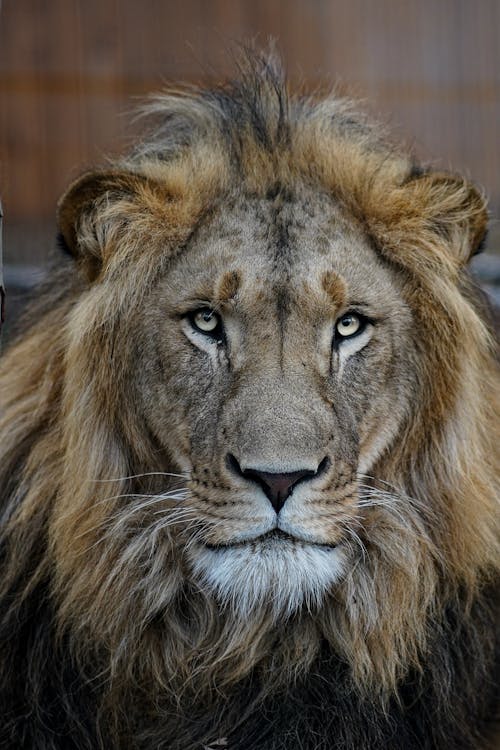
There are many contrasts that exist in life that are very helpful or quite confusing.
In a very challenging manner we may have been asked: “Are you strong or are you weak”? We are confronted with certain societal norms or expectations that at certain times in life we rise up to and even go beyond them or find ourselves wide of the mark!
Thanks to Ardit pexels.com

In this Insight I want to explore the contrasts and subsequent meaning between a Lion and a Lamb as found in Revelation Chapter Four and Five and its relevant context in the whole of Revelation.
Thanks to Kat pexels.com
It will also be interesting to see how that relates to our personal and church worship as outlined in this challenging definition of worship by Sinclair Ferguson
‘Where God is at the centre of things, worship inevitably follows.
Where there is no spirit of worship, there God has been dethroned and displaced’.
In 2004 I led a house group study of the book of Revelation and remember very clearly a phrase that summed up the challenge of trying to understand the writings of John and how that related to present and future living as a Christian in an increasingly secular world.
The phrase was worn confidently on a Tee-Shirt, ‘I have been mugged by the book of Revelation’. Hopefully as a result of this insight you might feel enlightened rather than having been mugged!
Just for a moment it will be helpful to consider how some people interpret the book of Revelation?
- It is important to see the book as a personal testimony from John that is relevant to today’s world, as it was in his day where he faced all kinds of evil and persecution and looked for the victory of Christ in his life as a strong Lion and also as a weak Lamb.
- The book in a prophetic form offers a survey of the history of the church with some of the prophecies having already been fulfilled like those found in the Old Testament and it has no equal in the New Testament.
- Some see that the book offers a precise prediction of how events will unfold at the, yet-to-come, end of the world. However, the difficulty of such a view is that world events change over time and can become irrelevant to believers throughout subsequent generations.
- It is more important I think to focus on what John actually Said, Saw and Heard. Overall the book is written to be understood and that certain blessings and cursing’s are in store for those who read it and take to heart what is contained within it. The contents of the book act as a ‘prophetic clock’ ready to show its exact timing of events when God wills it to be.
At this point it will be good to look at Chapter 4 and Chapter 5 in more detail?
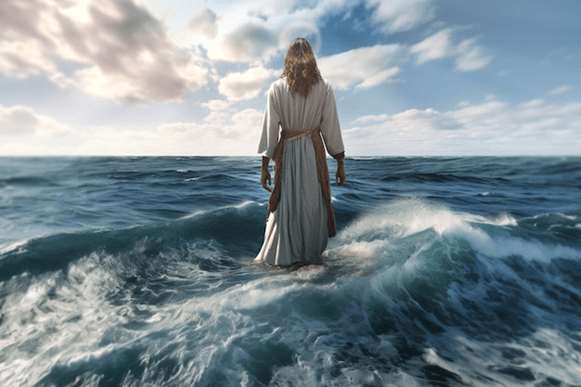
Thanks to freepik.com
When John concluded his seven messages to the churches in Asia Minor we might have forgotten that he was still on the Island of Patmos. In Chapter Four John looks up to the sky and sees a door open in heaven (v1) and he is encouraged to go through the door as “in the spirit”.
John see’s before him “a throne in heaven with someone sitting on it” (v2) and what he describes is quite classic in Jewish understanding in that nobody has ever seen God but here John sees a throne room that acts as a place of worship to the one sitting on the throne who has no name or title but has the appearance of “jasper and carnelian”.
For John the throne room represents the power and majesty of the one sitting on it which has a rainbow encircling it and nearby another 24 thrones and elders seated upon them (v4).
Finally, John sees four living creatures with eyes on every side who continually proclaimed “Holy, holy, holy is theLord God Almighty, who was and is and is to come”. (v8)
A story is told of a mother who asks her very young boy what he was drawing. He replied “God”. The mother responded “no one really knows what God looks like”. The boy confidently replied. “They will now’.
John looks up into heaven and see’s the one who is worshipped and it lasts a “day and night”. The place is full of active and continuous worship to God Almighty with all the elders at the very heart of its worship.
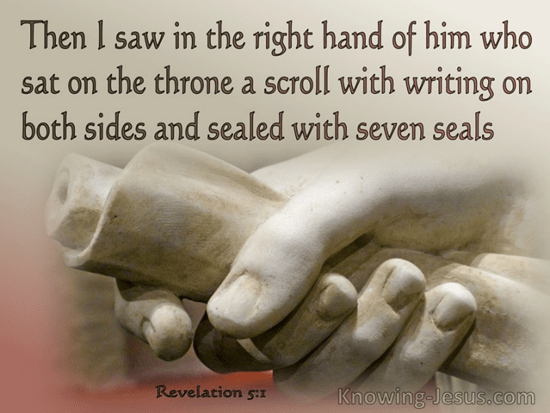
Thanks to Knowing Jesus
In Chapter Five John sees again a new vision and his attention is on a scroll with writing on both sides and it is sealed with seven seals held by the one seated on the throne. (v2) However, there was no one worthy to open the scroll and John found himself caught up emotionally in the scene and began to weep. (v4).
One of the elders told John not to cry because the Lion of Judah, the Root of David, had triumphed and was able to open the scroll and its seven seals.
The Lion is to be understood as the Jewish Messiah and appears as the Christian Messiah in the form of a Lamb who had been slain and had seven horns and seven eyes upon it (v6). John knew that such eyes could be compared to the seven spirits before the throne.
The Lamb is no stranger in the throne for it acts like an occupant of it, alongside the one seated upon it and is very distinct from the living creatures.
Here is a contrast between the Lion and the Lamb who as Jewish and Christian Messiah’s have both triumphed. The Lion is the slaughter Lamb! The mighty King is the crucified Jesus who has triumphed not by the sword but by his death and resurrection.
At this point we can compare Revelation to Matthew’s gospel where Jesus is described as the descendent of David, a son of Abraham (Matthew 1 v 1) and as Immanuel which means, “God with us” (Matthew 1 v 23).
The Apostle Paul also understands Jesus as a descendent of David who has power as the Son of God as revealed in his death and resurrection.
The Lamb then takes the scroll from the right hand of him who is sat on the throne (v7) and Jesus as the Lamb becomes the object of worship and all those present fall down before him which included thousands of angels.
In verse eight we have a reference to ‘the prayers of the saints’. Such prayers are more of praise than prayers of petition for one who is worthy to receive all praise and worship for all the works of creation and redemption.
This is mirrored in all the worship songs and hymns we sing within the church that are full of praise and thanksgiving to God as our creator and redeemer.
So what we find here in Chapter Five is that the one seated on the throne and the Lamb is both worthy of our continual praise and thanksgiving that forms our Christian worship (v13). So when we think of our God who we cannot see or know how he looks, we can know that he is both one to be both feared and worshipped!
John changes then the traditional Jewish view of Messiah as represented by a Lion, into one for the Christian described as a slaughtered Lamb and associated with the sovereign and risen Jesus that is acknowledged by all the creatures and elders in the throne room with a hearty Amen ‘So be it Lord’.
Throughout Revelation we have to assess how the writings of John would have impacted upon his own readers in the face of opposition and trial. There are many aspects of the book that are symbolicyet seek to convey a realmeaning to help the ‘saints’ maintain a faithful witness and be over comers even unto a possible death.
In closing, the creatures and elders before the throne continually praised the one sat on the throne and the Lamb close by.
Worship then is central to our life as a Christian and I refer back to our opening definition of it by Sinclair Ferguson
“Where God is at the centre of things, worship inevitably follows.
Where there is no spirit of worship, there God has been dethroned and displaced”.
To conclude:
- It is important to assess and reassess what we See and Hear on a daily basis and how we interpret things in the light of Jesus being a powerful Lion and a forgiving and redeeming Lamb.
- I remember a young man Mark who worked with the Message Ministry in Manchester and I invited him to speak at one of the Men’s Meetings I arranged a few years back. Physically he looked like a Lamb but when he opened his mouth and spoke about the Lord he was like a Lion and made a great impression upon us all as a witness to God’s grace and blessing upon him and all his ministry of praise and service.

Today if you feel like a Lamb turn to the Lion of Judah and find strength, healing and comfort.

If you feel like a Lion may it be on the basis of sacrificial and holy living as unto the Lord just like a gentle and humble woman and man of God.
Enjoy this beautiful worship song by Chris Bowater Jesus shall take the Highest Honour.
Selah: (Pause to think calmly on what has just been read) and check out A Time to Worship
 Explore to Inspire