
I would like to welcome Lynda as my special guest and thank her for being willing to ask me a very interesting spiritual and challenging question.
“I live in London and I am a mother, wife and grandmother and I have been a Christian for many years. My question is on the subject of hospitality which is a very broad subject and although I have practised being hospitable for a long time, should I be doing more as a Christian?
The Bible says that we should show hospitality to all people but what does that involve? Does it mean, just opening your home for a meal now and again or does it mean more than that, and also to whom should we extend such invites? Should we be careful as to whom we open our home to in this day and age? I hope this gives you something to work on Graham. Lynda”.

Rev Graham replies:
I have known Lynda and her husband for many years and observed clearly how they have quietly and often more publically practiced very simple hospitality to individuals and families alongside more lavish hospitality to wider family, friends and community.
Together they have worked hard and with much joy to offer a sense of laughter, comfort and happiness, however their ministry of hospitality is offered either by a simple meal, a time of fun and laughter, quality time given to listen and pray, or in the giving of private gifts that have made a huge difference to so many people in various ways.
Lynda has also had a wider ministry of serving her local community in sustaining and providing over many years a successful Laundry business and service. Within her local church Lynda has had a ministry of song and worship, a prayer clinic and offered personal support to many in need. In attempting to answer your question Lynda I want to try and offer a definition of hospitality (the word comes from the Latin to mean host, guest, stranger) from an Old Testament point of view and then a Greek perspective that both combine to form a Christian view of hospitality and how that might relate to how we as individuals and community may want to be hospitable within certain guidelines and boundaries.
Old Testament
One of the most important Jewish values over millennia has been the practise of hospitality (hakhnasat orchim) When people travel they can easily be at the mercy of others in respect to protection, shelter and food. In response to such basic needs the Old Testament encourages the value of being hospitable to the outsider, traveller, refugee, family, friends and neighbours.
A main reason for such thinking is that the Israelites were once aliens and strangers in a foreign land such as Egypt (Leviticus 19: 34) and thereby it is important to share kindness and generosity to those experiencing a similar situation. In Deuteronomy 14: 28 – 29 we note the importance of the third-year tithe that enabled food for foreigners to be collected and shared as a legal statute which had no equal in the ancient Near Eastern laws.
In Genesis 18 we have a situation in which three men (Angels) visited Abraham’s tent as strangers and were offered protection and hospitality in the form of a lavish feast. Abraham’s nephew Lot also offered food and protection to the men that contrasted sharply to those in the city who wanted to harm the men when they were visiting the town square in Sodom (Genesis 19). In their hospitality the Lord blessed both Abraham and Lot by providing an heir for Abraham and rescued Lot and his family from the destruction of Sodom.
By contrast we read in Judges 19 of a situation where a man and his wife prepared to rest in the Israelite town square of Gibeon, assuming that they would both be safe there. Fortunately, a man from Ephraim provided them a shelter, food and protection but despite that the local Gibeonites violated the couple that eventually led to a civil war and disgrace upon Israel.
Whether we are in a place at home or travelling in a foreign land, hospitality ensures a person some form of protection, shelter and sustenance. In that beautiful book of Ruth we read of the generous hospitality Ruth received as a Moabite woman in Israel.
In 1 Kings 17 we find that the prophet Elijah and then Elisha in 2 Kings 4 received generous hospitality and then in Exodus 2 we note that such hospitality shared, led to marriage for Moses. So in the Old Testament hospitality served as an important value and characteristic of how people should treat one another in the context of family or a complete stranger.
Greek Understanding
In ancient Greece we find that the customs of hospitality were encompassed in the understanding of ‘Xenia’ or translated as ‘guest friendship’. Historically, there was a moral obligation as well as a political imperative as how one treated foreigners and guests. Any activities that took place in the context of hospitality represented a respect and connection between a ‘guest’ and a ‘host’ expressed in both material and non-material benefits.
So within the application of ‘Xenia’ there are two basic rules:
1) The Host has to respect the Guest and to ensure that their requirements are met in full.
2) The Guest has to respect the Host and to acknowledge and appreciate any provisions supplied and if required, to ensure that the Host would be accommodated fully if they visited their Guest home when they travelled.
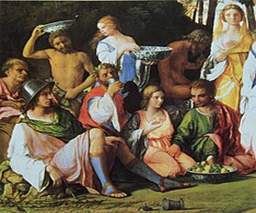
This photo is of a renaissance painting that displays traditional exchanges of gifts that included mythical gods. This represented the customary material and social exchanges involved in the concept of ‘Xenia’.
As the act of hospitality unfolds, through different actions and gifts, there will be some form of spirit felt and exchanged. People feel and appreciate a spirit of acceptance, love, fun and joy that makes those present feel happy and appreciated. By contrast there will be a spirit that begrudges what is taking place, a meanness, judgement, a lack of joy and fun whereby one feels unwelcomed and very much happy to leave as soon as possible.
New Testament
There are a number of examples where accepting the ‘stranger/guest’ is likened to welcoming Christ himself. We note the action of Jesus washing people’s feet, sharing a kiss of peace and anointing a person’s head with the oil given to him. As Jesus travelled he was welcomed and cared for with food and accommodation by many who knew him and those who didn’t particularly know him!
In Romans 12: 13 Paul speaks about the Christian duty to offer hospitality, especially to Christian brothers and sisters. In 1 Peter 4: 9 Peter tells his readers that hospitality should be offered ungrudgingly and with deep love. ‘It can be likened to a loving rainbow full of unconditional love, hope and joy.’

Then in Hebrews 13:2 we are told ‘do not neglect to show hospitality to strangers – for through it some have entertained angels.’ As Christians we are able to give freely because we have received freely from the Lord. This is a wonderful witness to none believers that Christians will and can be known by their love in practical actions as seen in the gift of hospitality.
Practising Hospitality
At this point Lynda I think it would be helpful to offer some practical guidance points that may help when thinking about how, to whom or not, we may offer hospitality.
1 What are my true intentions?
My mother was an amazing cook and baker, a professional cleaner and very sociable with lots of friends and well known in her neighbourhood. However, if she was asked to invite somebody to have a meal in the house, except for close family and friends, then she would freeze, in the context that she felt her home was not good enough and was embarrassed to entertain as such.
In offering hospitality our intentions should be pure and unconditional and not based on bragging or being ashamed about our status, home or ability to cook and entertain. Also we should not worry if we have a very basic home to share hospitality, as we will all have experienced to some degree that some of the best hospitality we have received has been in very humble surroundings!
2 What is the best environment?
There is a lot of evidence to support that in many cultures and situations the architecture of a home or building has been designed and constructed with the practise of hospitality central to it. In the home we may have to rearrange furniture and other items so as to accommodate our guest to ensure they feel comfortable and enjoy the hospitality on offer.
3 Who are the Guests?
In the book of James chapter two we are chastened when we honour the rich person over a poor person. In any situation of hospitality we might only offer exclusive invites to the exclusion of those who might appreciate it more. On the other hand there will be many times, when for various reasons, we have to say no to some guests and yes to others.
In Luke 14: 1- 14 Jesus was a guest at the table of a prominent Pharisee and knew people were watching and judging his actions. Jesus instructed that when we share hospitality we should not forget to invite the poor and needed as well as the rich and well. Also as we give out at a personal cost the Lord will be pleased and bless us but that should not be a motive for offering hospitality in the first place.
4 What are the best provisions to provide?
Personally I always feel, that as far as possible with budgets to be considered, we give our best to guests whatever their social status. We are not being snobbish in offering our best crockery and cutlery indeed we are honouring those who are going to use them. When we have visited somebodies home or places of entertainment with food and accommodation it is the overall impression and welcome that will stand out and be remembered for a long time.

Take away!
I think Lynda we can all increase our practise of hospitality in whatever form, especially to the stranger who might be in the greater need.
We do have a moral duty within society to ensure that everyone can expect and find personal protection from anyone seeking to harm them. We have a duty to try and ensure that all people both national and foreigner have a place of shelter when required and as we have seen in the growth of Food Banks over the years to ensure that everyone, not only has some basic food but feels that they are receiving generously more than enough food and sustenance for their daily requirements.
I remember some wise person sharing with us as a young family in our early days of church ministry that there is a time to share an open home with those in need but also there is a time to close the door so that those inside can find rest and comfort themselves after working hard in the care and hospitality of others (Nehemiah 7: 3).
Also we have to be wise as to those we are generous to because there will always be the ten percent who want to take advantage of any kindness that is offered and in so doing spoil it for the majority. Personal experience will help us along the way but certain safe guarding practises will help us also.
- It is important to remember those acts of love and special hospitality we have received personally over the years from a known or unknown Host.
- Be mindful of those times when we have given and sometimes begrudging offered hospitality to family, friends and strangers and how that impacted us and those in our company?
So Lynda thank you for your question which I have found very enlightening personally and may you continue to exercise your very personal and special gifts of entertaining and offering hospitality with your husband, family and many friends. They truly appreciate it and receive it as a gift of love from God, as through you, that in its own unqualified way has a lasting impact for good.
To conclude take time to listen and watch this amazing video Come to the Table by Mark Alan Schoolmeesters.
Graham
Selah: (Pause to think calmly on what has just been read) and check out A Time to Worship
 Explore to Inspire