
Hi Graham it’s good to be back again. Many years ago I went to the cinema to see The Devil Rides Out written by Dennis Wheatley. To be honest, it was very disturbing and really scared me so I’ve tended not to watch anything like that since!

Thank you freepik.com
However, I am curious to know what exorcism is all about and I wonder if you can enlighten me in some areas? I know the definition is that it’s the religious or spiritual practise of evicting demons or other malevolent spiritual entities from a person or area which is believed to be possessed but I wonder about the mechanics of doing this.
I understand that Jesus may have performed what we now refer to as exorcisms. How did these manifest themselves and what were the most outstanding examples of these? How are priests trained to carry them out these days and have you ever had to do one or more yourself? What do you have to do to protect yourself from evil spirits when carrying one out? And, in today’s world, do you see evil happening on a national or global scale?
Thanks for giving this one your consideration. I know these questions won’t be easy to answer but I also know how dedicated you are to getting to the bottom of religious and spiritual matters in order to educate those who question.
Rev Graham replies: it’s lovely to have you back Carol and your questions over the last two years have really been testing ones in terms of biblical and theological understanding and how some of the questions have applied to daily living both as a Christian and non believer.
Last year in December we covered the topic of the Paranormal that related to ghosts, mediums, fortune tellers, spiritualists, séances, trances and Ouija boards. In regards to your specific question Carol about the mechanics of conducting exorcisms that will vary in respect to particular church practices and guidelines and what may be required in a certain pastoral settings.
In essence any attempt to ‘evict demons or other malevolent spiritual entities from a person or area’ will require a deep Christian faith on the part of the one leading in the act of exorcism and praying that the power of the Triune God – Father, Son and Holy Spirit will evict any demonic influence upon an individual or certain situations successfully.
At this point it might be helpful to know what exorcisms took place in the Old and New Testaments and particularly in the life and ministry of Jesus. Then we can look at what practises and guidelines are available for local Priests, Ministers and Leaders to use in their own pastoral settings and then I will share about my own personal experiences and approach to such matters.
In conclusion my answer is a little bit longer than normal because of the nature of the question but I hope you will stay with me to the end as it will be beneficial to know what wisdom is required to protect us from evil spirits that exist in a modern world both locally and worldwide.
Old Testament Exorcisms
In general it seems that there is no common references to any practise of exorcism in the Old Testament however, in Babylonian and Egyptian writings we find that the practice of expelling evil spirits from people and places did exist and so by the time of Jesus’ ministry it was a normal experience and expectation.

Thank you freepik.com
In 1 Samuel 16: 18 – 23 we find that David caused an evil spirit of melancholia to depart on several occasions from King Saul. In the Apocryphal book of Tobit Chapter eight: 1- 3, that represents the Catholic and Orthodox biblical canon, a young Tobias expels a demon from their presence with the help of the angel Raphael. People who have experienced the effects of an evil presence seem to have expressed them in feelings such as distress, misery, injury, calamity and depression.
The nation of Israel continually turned away from the Lord and those who followed the Priestly Law believed in demons and labelled them as nameless destructive forces that were under God’s control and could be dispelled through the sacrifice of blood as used in the feast of Passover.
New Testament Exorcisms
It may be said that when Jesus cast out demons it demonstrated a sign of his authority over evil so as to impress his audiences and in some cases to correct the error of the Sadducees who did not believe in spirits.
In Luke 8 we find that Jesus was travelling to “every city and village preaching and bringing the glad tidings of the kingdom of God” and in that setting we note that Mary Magdalene had been tormented for a long time by seven demons until Jesus commanded them to flee.
Jesus seemed to use no mechanical aids, proofs or any particular form of prayer or called upon any outside power or authority to aid him. Jesus in various situations just said “I cast out” so drawing attention to his own resources and ability to exorcise demons. As a result of Jesus’ actions it seemed people were in fear and amazement of his work, with some even accusing him of being demon-possessed and using the power of Beelzebub to drive out demons.
Jesus was the first to link exorcism to a defeat of the devil with some thinking that he had a magical power. The disciples shared Jesus’ ministry of exorcism as found in Luke 9: 1 – 6 when they were commissioned to go into the world to preach the good news of Jesus and signs and wonders would follow and in the name of Jesus “they will cast out demons.”
Mark and Luke used as a simple command the powerful name and authority of Jesus rather than emphasising their own idea of place and authority, while confronting and defeating demons.
In the gospel of Matthew
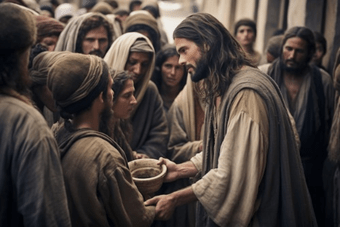
There are three references that highlight Jesus’ ministry of exorcism. In Matthew 7: 15- 23 Jesus spoke about how people conduct various ministries because the church during his time was affected by many false prophets who practised a form of exorcism. In Matthew 9: 32 – 34 Jesus heals a man who was demon-possessed and unable to speak.
Thank you freepik.com
The people exclaimed that “nothing like this has ever been seen in Israel.” However, the Pharisees disputed such comments by saying: “He casts out demons by the ruler of demons.” A similar dispute arises in Matthew 12: 22 – 30 where the source of power to dispel demons was questioned either it coming from Jesus or Satan as represented by Beelzebub.
In the gospel of Mark
In his travels Jesus entered Capernaum and taught in the Synagogue and cast out an unclean spirit in a man who challenged Jesus’ authority but later left the man. (Mark 1: 21 – 32). Both in Mark and Luke we note that any unclean spirits who came into the presence of Jesus fell down before him declaring that Jesus was “the Son of God” (Mark 3: 11 – 12 and Luke: 11: 14 – 23).
In Mark 3: 20 – 27 Jesus was accused of casting out demons by the power of Beelzebub but he pointed out that a house cannot be divided against itself and it was only God who casts out demons not Satan against his own demons.
In Mark 5: 1 – 20 and Luke 8 – 26 – 39 we read about the man who was healed from demon possession and the legion of demons that resided in him were sent into two thousand pigs nearby who then drown in the sea. In Mark 6: 7 – 13 Jesus sends out the twelve disciples with instructions to “cast out many demons and anointed many with oil who were sick and heal them.”
In Mark 9: 14 – 29 Jesus was visited by a boy who had been possessed by a demon from childhood. The father believed that Jesus could heal the boy but often such healing requires times of intense prayer and fasting.
Finally in Mark 16; 17 and Luke 9: 1 – 6 the disciples were commissioned to go into the entire world to preach the good news of Jesus and signs and wonders would follow, in the name of Jesus “they will cast out demons.” In Luke 10: 17 – 20 we find that seventy followers of Jesus had been sent out two by two and they returned to Jesus with joy saying “Lord, even the demons are subject to us in your name.”
In the gospel of John

Thank you freepik.com
For John the cross was the main focus of Jesus’s power and recorded no exorcisms by Jesus but he drew all people to himself as referenced in John 12: 32; John 14: 30 and John; 16: 11.
In Acts
Acts 16: 16 – 18 recalls how Paul on his way to pray met a slave girl who was possessed by an unclean spirit and helped her masters to profit from fortune telling. Paul was asked by the girl, for a number of days, to be healed but Paul got annoyed and then reluctantly cast out the spirit from the girl.
Paul did many unusual miracles with the result that many gathered certain items of clothing from him and took them to those who were sick and the diseases and evil spirits went out from them (Acts 19: 11 – 16).
Various Church Practises and Guidelines
The role of a Priest (often wearing purple) and a lay person who perform exorcisms are known as exorcist’s and with their special gifts and skills use prayers and liturgical formulae, symbols such as holy water and a cross, images, sacraments and worship.
There has been a long standing use of Psalms in relation to exorcism in the Jewish tradition, Psalm 91 and three unknown Psalms were discovered in the Dead Sea Scrolls. Also Psalm 69 has been used as a lament and a cry for help alongside confession of sin, imprecation (a spoken curse) and praise with Psalm 109 calling down curses on all of God’s enemies
Thank you freepik.com
An exorcist in the early church was one of four minor orders of the clergy and included the laying on of hands upon those mentally and spiritually challenged at catechumens and helping at Holy Communion. Such catechumens were exorcized from pagan and Jewish backgrounds as mentioned at the Council of Carthage in 255.
During the sixth century the First Book of Common Prayer in 1549 contained a formulae of prayers and a rite of exorcism that was used during infant baptism both in the Church of England and the Catholic Church with the intent of freeing an infant from any unclean spirits but then from 1552 such provision faded on the basis that not all un-baptised infants had unclean spirits within them.
The Priest, during infant baptism, addressed the Godfathers and Godmothers asking; “that they will renounce the devil and all his works, and constantly believe God’s holy Word, and obediently keep his commandments.”
So throughout church history the role of an exorcist has changed and developed in line with the rise and decline of church attendance. In 1604 Canon 72 in the Church of England forbid any priest to fast and pray and seek to cast out demons without a Bishops licence to practise. Today such a guidance will vary depending on parish needs and requirements.
Personal experience and approach
A ministry of exorcism is not my specific gift or calling but I having worked pastorally and extensively in and outside the church and with individuals, families and situations. In a very simple and real way, I have represented the love and saving power of God to transform people lives in the midst of deep loss, bereavement, sin, spiritual oppression, sadness and confusion.
When I was ministering as an Assistant Minister in a Church in Birkenhead Merseyside I worked with two colleagues, one a Senior Minister, who visited a person who was in great distress and felt oppressed by evil spirits.
They prayed specific prayers for healing and anointed her with oil and I along with others prayed during and after the visit for a complete casting out of any disturbed spirits that dwelt in the person’s life. I am not completely sure of the long term outcome but in the short term the person was transformed by God’s healing presence and appreciated the pastoral support.
I have visited various household dwellings where people have lived and expressed a demonic presence or influence that had represented itself in a cold and unpleasant presence that created fear, not faith or personal safety. Aligned to such visits I have conducted a number of House Blessings that include prayers for any evil presence that may have dwelt or disturbed the building and persons living in it from the past may depart in the powerful name of Jesus.
Thank you freepik.com
I have worked within and outside the church community for over forty years and I have come across many individuals who have asked for specific prayer to be freed from spiritual oppression and find healing and wholeness and that has been with fellow Christians as well.
There is always ongoing general prayers said for the nation, church, homes, individual and specific situations as prompted by the Lord that requires prayers for the devil to be denounced and defeated in the powerful name of Jesus. I have been involved in many healing services with other church leaders where people have requested prayers for healing and a release for demonic influences and have witnessed healings and restoration.
General advice for those affected by and working in the area Exorcisms
Thank you Carol for your question and I have enjoyed the challenge of trying to offer some insight that might be instructive for you and our readers concerning a very important topic.
Various church denominations will have their own guidelines for such a role and it is important to respect that and work in it for the safety and good reputation of the church body represented and on behalf of the Lord.
- In the Middle Ages a rite of exsuffation was used as an act of forcibly exhaling and breathing out air on the face of an infant three times with the words shared “Depart from him/her, thou unclean spirit , and give place to the Holy Spirit.” Such a prayer in a modern and appropriate manner may be useful to note and use if required.
- An Anglican exorcism rite of prayer may also be recalled and used within and outside the church with or without any permission where relevant. “I command you, every evil spirit, in the Name of God the Father Almighty, in the Name of Jesus Christ his only Son, and in the Name of the Holy Spirit, that harming no one you depart from this creature of God, N., and return to the place appointed you, there to remain forever.”
- In the Rite of Exorcism (Holy See 1999) and Cannon law in the Church of England it was only an ordained priest or higher prelate who was able to perform with the express permission of the local bishop and only after a careful medical examination to exclude the possibility of mental illness. Such guidelines are still relevant and again in whatever situation we find ourselves in with the support of another and not alone it is advisable to:
- “Carry our prayers up to God’s throne, that the mercy of the Lord may quickly come and lay hold of the beast, the serpent of old, Satan and his demons, casting him in chains into the abyss, so that he can no longer seduce the nations.”
Thank you freepik.com
In any aspect of ministry and prayer we should never believe or assume that we have any spiritual power within ourselves. As leaders and believers we act as a conduit for the Lord so that any disturbing evil presence will be dispersed in the name of Jesus and under the power of the Father and Holy Spirit that seeks to bring healing and recovery to broken lives and situations.
Due to many pastoral needs, the practice of some form of exorcism will be required. The world has rejected a lot of biblical understanding in regards to the influence of evil forces. Many in a naïve and simplistic manner believe that nothing can be aligned to the activity of demons as witnessed in the growth of Halloween and pretend that any associated practices of evil are not real or damaging.
However, what remains is that to cast out demons requires deep faith, believing prayer, elements of the sacraments that includes the symbol of the cross. It can be beneficial to express and share in vibrant Christian worship with symbolic candle light and sacred incense that represents a dispelling of any demonic forces from all people and situations. Above all may we remember that “the one who is in you is greater than the one who is in the world” 1 John 4: 4.
Graham
Selah: (Pause to think calmly on what has just been read)
 Explore to Inspire


