
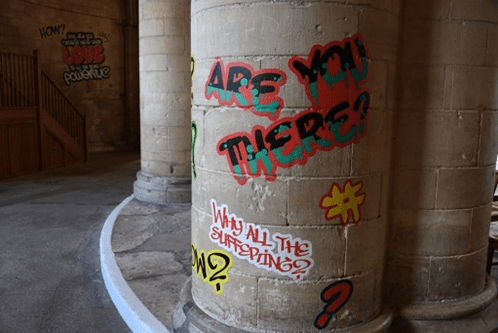
In the news recently (October 2025) there has been praise and criticism about questions that are exhibited in graffiti and posted within Canterbury Cathedral. A number of questions, under the title of Hear Us, represents a collaboration between the poet Alex Velis, and the Cathedral curator, Jacquiline Creswell.
Thank you Church Times
In this section of the website I seek to reflect difficult and contemporary questions that various individuals have wanted to ask and in some measure find an answer. So in that context I thought it would be good to highlight the questions raised by Alex on large graffiti-style graphics and maybe provide a comment on them?
Firstly it may be helpful to hear what criticism came very swiftly concerning the graffiti from the US Vice-President, J. D. Vance, who posted on X: “It’s weird to me that these people don’t see the irony of honouring ‘marginalised communities’ by making a beautiful historical building really ugly.” Elon Musk weighed in with the comment “Shameful”.
Other early reactions from visitors to the cathedral reportedly include one who described the installation as “sacrilegious”, and another who suggested it made the building “look like an underground car park in Peckham”.
Such comments may have individual value but overall I think they have missed the point of the whole exhibition! The installation will remain in Canterbury Cathedral until 18 January.
For a moment may we think about the graffiti questions that were compiled by various individuals in workshops that represented marginalised communities?
- “Are you there?” – This relates to the existence of a divine!
- “Why did you create hate when love is by far more powerful?” – A great question!
- “Does everything have a soul?” – Life is such a mystery both physical and spiritual!
- “Does our struggle mean anything?” – Where is God at work within suffering?
“Language is the people who speak it, and graffiti is the language of the unheard,” Mr Vellis said, “by temporarily putting graffiti on the inside of Canterbury Cathedral, we join a chorus of the forgotten, the lost, and the wondrous.”
Jacquiline Creswell, who was arts curator at Salisbury Cathedral for 12 years, says of her work: “Churches have employed the visual arts for centuries, to celebrate their faith and communicate its truth and beauty. This can also be a medium for discussing and exploring that faith by providing a catalyst for including others into the discussions.”
In an interview in 2022, she said: “By reaching out to the divine with personal inquiries, individuals may find comfort, clarity, and direction amidst life’s uncertainties”.
When we think about the life of Jesus and his interactions with many diverse and cross–cultural people he asked between 307 to around 150 questions and responded to each one in his own way. I have highlighted five questions.
- “But who do you say that I am”? (Matt 16:15) – The validity of Jesus has always been questioned!
- “Woman where are they, has no one condemned you”? (John 8:10) – The woman at the well was forgiven and told to sin no more!
- “Why do you notice the splinter in your brother’s eye yet fail to perceive the wooden beam in your own eye”? (Matt 7:2) – We love to judge others when we have so much to consider in our own lives!
- “My God, My God, why have you forsaken me”? (Matt 27:46) – Can we ever understand the suffering of Jesus and the suffering of humankind!
- Satan posed a number of questions to Jesus, asking him to follow him and prove himself as the Son of God! – Jesus replied “Away from me Satan!” (Matthew 4: 3, 10)
There are a lot of questions people asked Jesus that are still very relevant to our modern world today, as I found in this very interesting blog by Pastor Michael in the Good News Herald that outlines ten questions, of which I will only refer to four below:
- The Chief Priests and Elders asked: “By what authority are you doing these things, and who gave you this authority”? (Matt. 21:23)
- The Rich Young Ruler asked: “Good Teacher, what shall I do to inherit eternal life”? (Matt. 19:16)
- The Lawyer asked: “Teacher, what shall I do to inherit eternal life”? (Luke 10:25; Teacher, which is the great commandment of the Law? (Matt. 22:35-36)
- The Disciples asked: “Who then is greatest in the kingdom of heaven”? (Matt. 18:1)
The early and established church has asked and complied lots of questions and answers. Many theologians and church leaders have shared their knowledge and wisdom so as to maintain faith in God and the church as found in the form of Creedal Statements such as The Apostles’ Creed and The Nicene Creed.
In the Apostles’ Creed below: it relates to questions around Creation, The Virgin Birth and The Death and Resurrection of Jesus. Judgment for the living and dead and the place of The Church on Earth.
‘I believe in God, the Father almighty, creator of heaven and earth.
I believe in Jesus Christ, his only Son, our Lord, who was conceived
by the Holy Spirit, born of the Virgin Mary, suffered under Pontius Pilate,
was crucified, died, and was buried; he descended to the dead.
On the third day he rose again; he ascended into heaven, he is seated at the right hand of the Father, and he will come to judge the living and the dead.
I believe in the Holy Spirit, the holy catholic Church, the communion of saints, the forgiveness of sins, the resurrection of the body, and the life everlasting’.
Within and outside the church we all have differing beliefs and philosophies. They may range from being, atheistic and secular. To liberal, conservative and orthodox. We all have unanswered questions and are constantly seeking unattainable answers! That is where true faith and trust in God’s sovereignty minimizes any doubt and unbelief we may harbour.
Canterbury Cathedral Thank you unsplash.com
Within Cathedrals, Churches and House Groups, whether in a formal or informal manner, they seek in their own ways, to exhibit a living presence of God the Father, Son and Holy Spirt that passes all human understanding and many miss-understandings!
Many of those who attended the workshops had a faith in God but felt intimidated to enter a Cathedral. In seeking to know and find God in a personal manner we need to feel accepted, comfortable and forgiven.
Such acceptance enables us to ask the obvious and mysterious questions of life, to hopefully find not complete answers, but a living presence of God by his Holy Spirit that makes all the difference and even enables us to enter a Cathedral, Church or House Group as Mr Vellis said as a “chorus of the forgotten, the lost, and the wondrous”.
Graham
Selah: (Pause to think calmly on what has just been read) and check out A Time to Worship and Motivational Moments
 Explore to Inspire