At my local church I was recently given the Bible readings from Acts Chapter 2: 14 – 29 and John 20: 19 – 26 to preach from. In praying and thinking about the readings I felt that there was a pertinent question I had to think about for myself which also applies to each and every one of us both in and outside the church.
So for a new question and answer I want us to think about whether: “It is better to forgive or to retain the transgressions, those things that have hurt and offended us, or to retain them and never forgive and certainty not forget them”?

Thank you Mohamed pixabay.com
The timing of the preaching was just after Holy Week having recalled all the sadness, drama and horrible death of Jesus. During such a time, and many other life situations, we may feel a little flat spiritually but it may be helpful to reconsider how the disciples may have felt with the loss of their humble yet charismatic leader? Certainly they would have felt lost, confused, fearful and so much more!
Acts 2: 14 – 29
In our first reading from Acts we find the apostle Peter speaking with the other disciples beside him, to a crowd of residents within Jerusalem. Greetings (Rejoice) he proclaims. He continues to offer an overall explanation of what had just happened concerning the life, death and resurrection of Jesus. He proclaimed that the disciples were not drunk, but were filled with the Holy Spirt as a result of the departed Jesus as predicted by the prophets of old.
John: 19 – 26
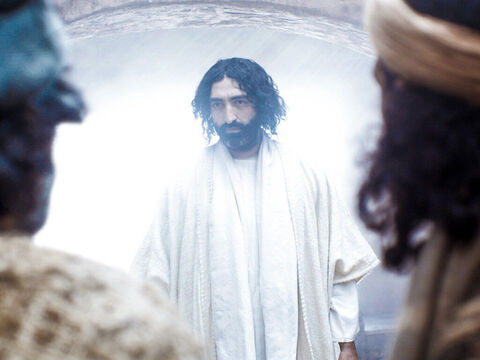
In this chapter of John’s gospel, the disciples had been informed by the women that Jesus had risen from the dead, as he had spoken about. In their shock they also became excited as they gathered together behind closed doors. Jesus greeted and spoke to them about a specific aspect of his ministry and showed them, as proof of his death, his hands and his side.
In reaction to the words of Jesus the disciples ‘rejoiced, they were delighted, in rapture and ecstasy’ as outlined in the Amplified Bible. Jesus continued and said to them “Peace to You”. As I was sent by the Father, I send you and breathed on them, which represented a personal infilling and presence of the Holy Spirit.
Then in verse 23, he proclaimed: “if you forgive the sins of any one they are forgiven”. However, he added a caution “if you retain the sins of any one, they are retained” (not forgiven).
Thank you freebibleimages.org
The Peace
It’s very interesting in regards to the use of The Peace as we may know it. How it is generally used in church liturgy and in a broader use and understanding. In saying the phrase ‘Peace be unto you’ (verses 19 and 21) it acted as a social greeting/salutation, similar to Hello, Rejoice, Be Happy, Best Wishes etc.
Yet in the context of Jesus’s ministry it was a Pardoned Peace that Jesus shared and in reality was a totally unique and personal peace as represented in his words and actions. So the Peace of Jesus is a peace of pardoned sin that is different from any human greeting and best wishes.
We receive a Pardoned Peace, as we confess our own sins before the Lord. We can only truly forgive the offences of others towards us when we have been forgiven as expressed in the Lord’s Prayer. Human forgiveness is very important but the Lord’s forgiveness goes deeper and lasts longer! At this point it may be helpful to apply our thinking to such powerful and challenging thoughts?
Human Relationships
In John Chapter 8: 7 Jesus is in discussion with the woman caught in adultery and to those ready to condemn her he wrote on the ground: “Let him/her who is without sin among you be the first to throw a stone at her”. As we continue to read, nobody cast a stone, for none of us are without sin!
It is only Jesus’s pardon that brings peace.
In Work/Business Practises and Ethics
Jesus would have had experience of working with his father, brothers and others in their Carpentry Business. People would have offended him in unpaid debts, critical words and actions and so much more. In everyday ways he would have had to forgive and sought forgiveness, as we all bump into each other constantly.
It is only Jesus’s pardon that brings peace.
The Unforgiving Servant
In Matthew Chapter 18, we read about Peter asking Jesus another question as to how many times should we forgive. Peter thought that he was being generous about how many times to forgive a brother or sister and in his conversation with Jesus even attempted to answer his own question in suggesting one should forgive a brother or sister seven times.
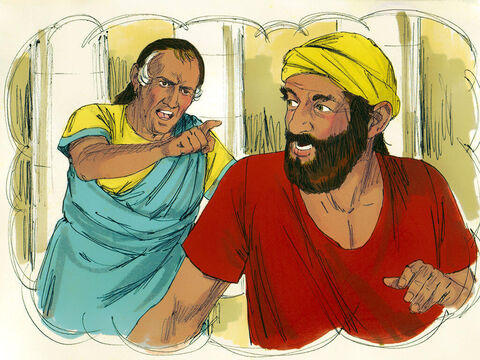
In the parable Jesus makes reference to a King who kindly forgave a large debt owed to him by one of his servants. Sadly, that servant did not replicate the example and forgiveness afforded to him and even attempted to choke his fellow servant who owed him money in an attempt to get back what was owed to him! He then ended up in prison until he paid all that he owed.
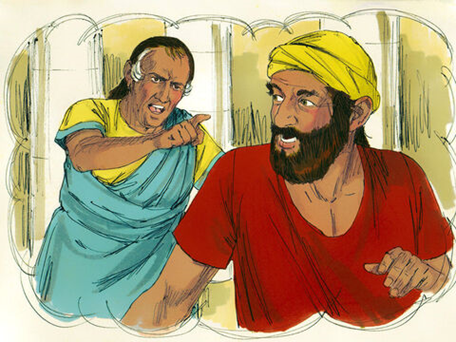
The unforgiving servant freebibleimages.org
In certain Rabbinic Teachings, as found in Amos Chapter1: 3 and 6 and Chapter 2, nations who transgressed each other up to three times would be forgiven but on the fourth transgression they would be punished. The general convention was to forgive three times but after that not to forgive, as nations and individuals had been given an opportunity to be forgiven.
It was also believed that a person couldn’t be more gracious than Godand therefore any forgiveness was limited to three times. So Peter was actually going beyond such conventions and being very generous with seven.
However, Jesus in answering Peter went even further and suggested that the act of forgiveness should be seventy times seven, meaning it should be available and offered continually and generously just as our heavenly Father forgives, so there is no limits to forgiving.
It is only Jesus’s pardon that brings peace.
Reality
It is a fact that we often forget that how we forgive or not forgive affects us more personally than those who have offended and sinned against us!
Each one of us in various life situations have to work out how to forgive people in practical terms. In retaining the sins of others we often want some form of restitution that in the main does not happen as we would like or want!
What then transpires? We retain the sins of those who have transgressed us rather than forgive them. In such a situation who is the poorer? The unforgiving person or the person who has forgotten they have offended and simply go on to offend others without any sense of guilt or shame! The answer: we are, if we retain the sins of others!
Un-forgiveness in all its forms does not allow for a full pardon and a continuous and perfect peace.
It is only Jesus’s pardon that brings peace.
Take Away
The next time you are in a church service and are asked to share The Peace to each other. Remember the difference between a salutation/greetings peace and the pardoned peace of Jesus. After the service has ended and we enter into the week ahead will we greet family, friends and others with great love, joy and peace or fear, sadness and resentment?
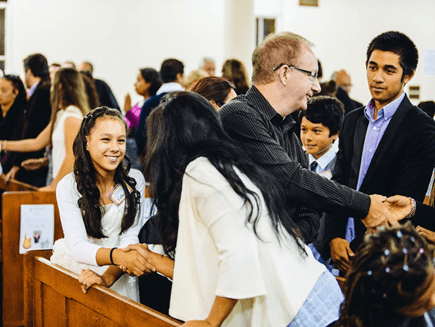
The sign of the peace thanks praytellblog.com
The continued question for all of us inside and outside the church, is to what extent will we fully forgive or retain the transgressions, short comings and sins of those made against us, intentionally or unintentionally?
That sounds like another question to think about for another day, related to those heartfelt words of Jesus when being crucified. “Father, forgive them, for they know not what they do” (Luke 23:34).
- In concluding our reflection on how to deal with the issue of sin and offence may, we bring our fears, confusions and disappointments to the Lord?
- May we rejoice in being Easter people and all that the Easter story represents, for all who turn in repentance and faith and are serious followers of Jesus?
- May we know a pardon and forgiveness of our own sins and short comings and in so doing not retain the sins and short comings of those who have offended us.
- Finally: Jesus says to each one of us today “A Pardoned Peace to You”.
- May we know and share the Peace of the Lord to all we meet. A peace that passes all understanding and misunderstanding body, mind and spirit this day and all the days to come.
Selah: (Pause to think calmly on what has just been read) and check out A Time to Worship and Motivational Moments