
Hi Graham – it’s good to be back again after such a long time. I hope you will be able to respond to a seasonal question which has actually bugged me for a long time.
At this time of year, the shops have been full of Christmas gifts, cards and a whole host of other items we never knew we needed. So much financial pressure and stress is put on people who, quite often, can’t afford to blow money they haven’t got on presents other people don’t want or need. In many cases, the real message of Christmas is well and truly lost and it becomes all about commercial consumerism.
Thank you Duane unsplash.com
When we look at Christmas cards, and particularly religious ones, we see the idyllic stable scene with the Holy Family, shepherds, an assortment of animals and the three Kings. From what I’ve seen and heard, this scene didn’t actually take place in reality and, in fact, the Kings arrived much later – one suggestion I heard many years ago was that it was around 40 years later.
From your own theological training and research, have you ever come across any definitive timeline when the Kings did actually arrive? I know it is very difficult to state categorically the exact timing of this event, especially as the Bible wasn’t written until many years after Jesus’ crucifixion, but it would be good if you could offer some more precise information on this.
Rev Graham replies:
Hi Carol it is great to have you back and as always we appreciate your thoughtful and challenging questions around the reality and mysteries of the Christian faith in a contemporary manner.
Interpretation
Recently I heard a comment from Michael Rosen the co-writer of the song ‘We’re going on a bear hunt’, saying that for him Christmas is all about light overcoming and replacing the darkness of winter. He made no historical or religious deference to the possibility that Christmas might actually be about the reality and birth of Jesus Christ!
Many of us believe what we want to believe in the context of our own particular views having faith or no faith and irrespective of times, seasons and interpretations. Equally, many of us, particularly of the Christian faith, will refer to Holy Scripture for wisdom and guidance as to how certain events in world and church history connect to the past, present and the future.
In attempting to answer your question Carol, it will be a very brief summary that includes little facts but lots of tradition, conjecture and debate!
The Visit and Timeline of the Magi
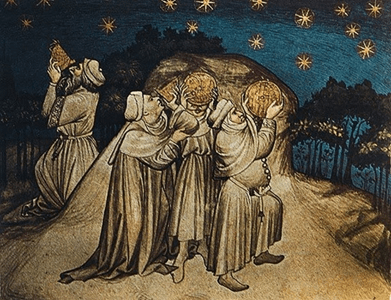
The term Magi is referred to in the classical writings of Herodotus (i.101, 132). It refers to a group of people known as the Medes who exercised a priestly function within the Persian Empire.
Thank you ancientpages.com
In the book of Daniel 1: 17 – 21 there is a reference to ‘wise men’ or ‘astrologers’ who were able to interpret dreams and messages from the gods and there are also references in the book of Acts 8: 9 and Acts 13: 6 – 12. It may be safe to say at this point, that the Magi were non-Jewish wise men, Kings and astrologers who concluded from their studies that in the future there was to take place the birth of a promised Jewish King in the region of Bethlehem in Judea. Geographically the areas they travelled from was mainly in the east such as Arabia, Babylon and elsewhere.
In the Gospels we have the various accounts of the foretelling of a Messiah’s birth, the conception of Mary and the shock Joseph would have felt. There are warning and guiding dreams to Mary, Joseph and the Magi. We have the actions and presence of angels and the Holy Spirit.
We have the testimony of the humble Shepherds and the Kingly Magi that represents how the baby and infant/child Jesus (Matthew 2: 11) appealed to all levels of human strata. We have the drama and madness of King Herod who jealously wanted to eliminate any baby King who threatened his authority.
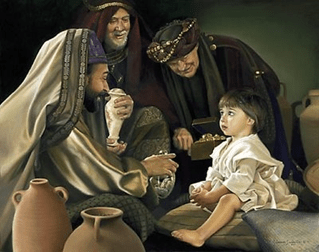
In reading Matthew Chapter 2 it speaks about the Magi, or wise men who travelled from the East in search of the Christ child. They inquired of King Herod where they might find Him, saying, “Where is he who has been born king of the Jews? For we saw his star when it rose and have come to worship him” When they visited Jesus they humbly “bowed down and worshiped him”. Then they opened their treasures and presented him with gifts of “gold, frankincense and myrrh” v 11
Many have questioned the historicity of the visit, in part due to the silence of other reputable sources mentioning the actual event and the slaughter by Herod of infants. Therefore from Matthew we have a story that refers to a star over Bethlehem which does not necessarily contradict the actual reality of the birth of Jesus as a Messiah to the Jewish and Gentile world and the actions and nature of King Herod.
In regards to any scientific proof of the movements of a star at that time there are numerous studies that make reference to such a star. For example Halley’s Comet in 11bc and the activities of Jupiter and Saturn around 7bc and 4bc! So we are not sure what star the Magi followed but they were the experts of their day and the story is not a legend but real in its own way and timing.
There has existed lots of discussion around the exact timing of the birth of Jesus and when the visit of the Magi took place. The Gospels do offer certain orders of events and timings but that has also been shaped by church tradition and historical interpretations as found in the study of scripture.
If we have an understanding as to when the Magi visited Jesus it would aid us to ascertain the early years of Jesus and how the church has interpreted them. In regards to how many visited Jesus it ranges from three that is often aligned with the three gifts, to twelve or many more!
If we conclude that the star appeared at the time of the birth of Jesus and when the Magi departed, then their journey would have lasted about ten days. The traditional date of celebrating the visit of the Magi, within the Western church, is on the 6th of January, twelve nights till the 5th of January and thirteen days after the birth of Jesus. Traditionally the Feast of Epiphany also includes the baptism of Jesus and his first miracle at Cana.
Thank you Pinterest
Not everyone agrees on the timing of the Magi. The early church fathers Eusebius and Epiphanius, in referencing Matthew 2: 11 felt that the Magi would have visited Jesus around two years after his birth as an infant and not as a baby. Consequently, many feel that the date of Epiphany has been selected for church liturgical use rather than any historical fact.
Takeaway
However we interpret the Christmas story and the visit of the non-religious Magi to the infant Jesus, we will all engage in our own unique ‘bear hunts’ and journeys in life. We have to work out how best to follow any leading and guiding that might include stars or other means that may lead us to something special, or we just might end up chasing illusive rainbows and pipe dreams!
It is interesting to read about the shenanigans of the Jewish and Roman leaders who represented the religious and secular authorities of the day. They were embarrassed and called out for not accepting God’s different will and pathway in regards to the expected Messiah and the non-political ministry of Jesus. Throughout world history and even to our present day authorities want to control narratives and outcomes, rather than seeking, in a wise way, a present and future will of God.
The Magi had a willingness to follow a start in the East and give humble homage to Jesus. They had a head and a heart belief that would have cost them in time and money. Faith is never a hundred percent sure, but it can be trusted and applied and brings fulfilment in its own way.
When we feel self-assured and raised up we can be brought low and humbled. In humility we may be raised up for as we “draw near to God, he will draw near to us” as outlined in the book of James 4: 8. So today in a new season and differing timings may we have the crucified and resurrected Jesus as our guiding star rather than any human fame or riches.
Selah: (Pause to think calmly on what has just been read) and check out A Time to Worship and Motivational Moments
Graham
 Explore to Inspire

