Song of Songs Poem Four (Chapter 5: 2 – 6: 3)
Following on from the Third Poem we can now consider what the Fourth Poem contains and how once again that might be important in maintaining our covenant love to God and embracing both human and divine love to each other for the benefit of all the communities we live in.

The song of Solomon with flowers Thanks renuga stockadobe.com
At this point it might be helpful for you to read the Fourth Poem as found in Chapter 5: 2 – Chapter 6: 3.Your understanding will vary according to what version of the Bible you may use!
Backstory – The Beauty of Love in a dream or in reality!
At certain times in life the beauty of love can seem like a dream, as found in Chapter 3: 1- 5, or a reality of life. However we may interpret the Fourth Poem the verses are very vivid, intense and full of drama.
There are around 21 dreams recorded in the Bible that may bring warning or comfort. They also convey thoughts of guidance, hope and a promised future. In any experiences of love, excitement and anxiety can be manifested in our dreams.
Some dreams can feel like nightmares that disturb us and challenge any love and relationships in real life. Dreams can feel like real desires and ambitions that can be frustrated or lost forever. They can represent a disabling of breathing, walking and others activities.
Characters
Central to this Fourth Poem is the bride who has consummated her love to and with her beloved shepherd. However, they experience a separation and disturbance in their relationship that causes her to have dealings with the street police either in a dream or reality. Once again we hear conversations between the bride and the daughters of Jerusalem.
Dialogue
Chapter 5: 2 – 8
In verse 2 it seems that the bride is half dreaming and half-awake with different emotions and meanings conveyed. In verse 4 the bride is settling down to sleep when she hears a knock on the door with the shepherd wanting to meet up again but she is reluctant to answer it.
The shepherd has returned from looking after his flock and has wet hair from the heavy dew of the night. There is no playful or serious response to his knocking so he moves away and the bride thinks that she has offended and lost him but retains an excitement to meet him again.
The bride’s semi conscience state borders on a nightmare and seemingly in her dream she rushes into the public square to find her shepherd. She comes into contact with the street police who are not happy with her questions and physically attack her.
Chapter 5: 9 – 16
The bribe turns to those cynical bystanders, the women of the night, who argue what is so special about him? “Surely he is just like any other man and therefore is no different or special”. The bride’s reply to the women was to declare her unconditional love for the shepherd, as he is the ‘best of the best’.
In verses 10 – 15 the bride gives a full description of the shepherd from head to toe as one who is very radiant and handsome. He has dark hair, clear eyes and with his beard has a fragrant complexion. Overall he has a very robust body with legs like alabaster columns and is gracious just like a beautiful statue.
He is a very desirable man deep and rich in speech and likened to the mountains of Lebanon and cedars trees in a deep forest. She proclaims that her beloved is “altogether desirable” who I am “sick with love”.
Chapter 6: 1 – 3
The question found in verse 1 is similar to that in chapter 5: 9 where the women mockingly want to help the bribe find her beloved. She does not require their help as she knows where he is and has gone to and reminds herself that such drama and anxiety was only in the form of a dream and not reality.
Amazingly the women are impressed by the outline of her loved one and her devotion to him and would like to see him for themselves. The dream ends and she is reassured that her beloved shepherd is devoted to her as expressed in verse 3 – “my beloved is mine, he browses among the lilies”.
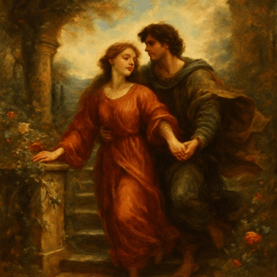
In these verses we have once again the expression of love having been found, then lost and then reunited, which is quite similar to all the romantic novels and films that we have read or seen. This follows the ‘helical principal of creation and redemption’ – life, death and resurrection. The bride has fallen in love but it is only when she feels that she might have lost her beloved, that she fully appreciates what she has and values it accordingly.
It is so true on many levels that the expression and feeling of love in all its forms, may grant to us a full expression and understanding of life and in which we should never take for granted.
One aspect about a strong and true love is that physical distance does not have to weaken it for it can become even stronger. Think of a loved one who lives a distance away and times together are few and far between. Then compare that to those who live near to us and we see them often.
Both loves, be they near or far, are felt and expressed in different ways and required specific approaches and actions to maintain such love. The beauty of any couple’s love is that when they are near or far their mutual love remains constant and strong.
Flowers represent joy and delight at different times and seasons in a garden and field. In verse 2 the gathering of lilies may represent the shepherds ‘love posy’. When we think of Jesus as the Bridegroom of the Church, he is not present in a physical manner but his spirit and example lives in the hearts and lives of all his followers as a ‘love posy’ and a promise of a future life together on earth as in heaven.
Takeaway
This Fourth Poem is similar to the other Poems in that it gives us a greater appreciation of marriage and committed relationships that include physical intimacy alongside companionship and spiritual harmony.
Any couple that are in tune with each other’s feelings expressed or otherwise will appreciate as found in Ecclesiastes 3, that there is a ‘time to embrace and a time not to embrace’ and in both cases it should not hinder a couple’s love but hopefully strengthen it. In this Poem the couple are beginning to learn how such love develops and in what ways each one should adapt and be accommodating.
Depending upon how we have been brought up and in what culture and environment we have experienced, we should not be ashamed of how we enter into love. Also, depending on our individual encounters of love we may learn how to recover and forgive, and to be ready to be more open and loving.
The bribe was very proud of her beloved and happy to share that. Yet as we have learnt from the Third Poem it is also important to ensure that on certain times and occasions a couple’s love as in the example of the ‘Enclosed Garden’ (in Chapter 4:verses 13 – 15) is kept secure and true.

Thank you bible.art
Our spiritual relationship and love to God can mirror that of the bride and shepherd with the added bonus that “the steadfast love of the Lord endures forever” Psalm 107 v 1. How happy and blessed we are that when we forsake God’s love and holiness he is willing to welcome us back not in a dream like manner but in reality, as a prelude to the promise of eternal life with God through Jesus Christ our Saviour and Lord.
Selah: (Pause to think calmly on what has just been read) and check out A Time to Worship and Motivational Moments
Graham
 Explore to Inspire