I must confess that in all my years of preaching and teaching I haven’t referred to the Song of Solomon that often. It represents a love story in five poetic forms rather than a theological discourse. In five Insights I want to consider its place and importance within the church and to what extent does it aid our daily Christian life and witness.

The song of Solomon with flowers Thanks renuga stockadobe.com
I also confess that it is quite confusing as to how to interpret The Song in a poetic and devotional form, rather than a text to be theologically dissected. The book can be interpreted in a number of ways and according to how you view The Song it will affect your value and application of it.
1) There is the allegorical interpretation (that conveys a hidden meaning in a different form). The Song represents a love relationship between God and his people, Christ and his bride the church which has been popular from the Middle Ages. In one sense it can easily undermine The Songs endorsement of the importance of marital love and spiritual intimacy between two people, God and his church.
2) The Song can be viewed from an anthological point of view (a book of different works with a common theme). It contains five poems around the theme of human love. However, in such a form it lacks a particular and understandable narrative!
3) A further view includes a Shepherd that became popular from the 1800’s. Two peasants are in love and find that King Solomon try’s to entice the Shulamite women into his harem. The women resists Solomon’s advances and remains true to the shepherd.
As you may experience yourself, it is hard as we read The Song to discern when it is the Shepherd or Solomon speaking and it seems that there are only two descriptive titles not three, as in the case of a love triangle. It can be argued that such a view may suggest that Solomon wrote The Song and portrayed himself as the bad guy while praising the faithful love of the peasants!
4) The Solomon Shulamite view. The couple in love are devoted to each other and look to get married. They later experience a temporary separation and then a welcomed reunion and delight themselves in a final affirmation of each other’s love. The difficulty in such a view is that it is not certain who the Shulamite women was, compared to Solomon’s other marriages.
In whatever way we may approach and view The Song, within the Jewish and Christian traditions it represents a loving relationship between Yahweh and Israel and Jesus and the Church. It is important to try to understand how it may fit into the modern world with all its competing values such as exclusive asceticism (abstaining from any indulgent behaviour) and excessive and abusive human relationships!
At this point it might be helpful for you to read the First Poem as found in Chapter 1: 5 – 2: -7 NIV and your understanding will vary according to what version of the Bible you may use!
Backstory
We all have a backstory in life and it will be helpful to consider how The Song was formed and accepted within the Bible. In regards to its authorship it is thought to be either by King Solomon or for Him, as in the Hebrew it can mean both! Some Jewish traditions ascribe The Song to King Hezekiah and placed it in the post Solomon period. It might be safe to say that the issue of date and authorship does not exclude any value and use of the book, especially for modern day living.
Characters
Within this First Poem we have reference to a peasant girl or young maiden from Shulamite (Jerusalem). We also have reference to her mother and working brothers. We have an intriguing mention of the maidens love for her shepherd friend. Then there is the chorus of individuals known as the sisters or daughters of Jerusalem that represent the harem of Solomon. Lastly but not least we have King Solomon himself.
Dialogue
The above mentioned characters interact with each other in this First Poem in quite a furious manner and it can be hard to actually understand who is who and what message is being communicated or not!
In the first eight verses we hear from the maiden, a Shulamite, who is young and innocent and finds herself in the company of very worldly wise daughters of Jerusalem that constitutes Solomon’s harem. When Solomon makes an appearance, the women speak up in love and devotion to him and want to be acknowledged and loved for themselves. The women in the harem are jealous of the maiden’s looks.
There are a number of physical references to places such as the Kings’ dining room, the fragrance of perfume and the wonder of the King’s name when mentioned. It is understood that love, is like the beauty of fine wine that brings with it great joy and gladness.
The maid and bride to be, describes herself as one who has a dark skin tone that has come from being constantly exposed to the sun. She has worked very hard in the vineyards with her brothers and has neglected to take care of her own skin which she compares to the ‘black goat haired tents’ situated near to her.
The maiden then turns from speaking with the women in the court to the absent love of her life, the shepherd. Where are you working she asks and wants to meet up with him? The women hear the maidens cry and encourage her to meet up with him and return to her shepherd life and give up her royal honours that she has just gained.

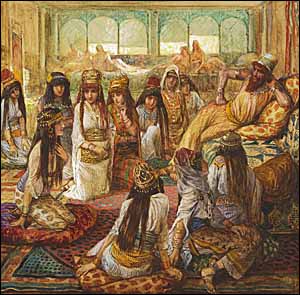
James J. Tissot, ‘Solomon and His Harem’ (1896-1902), gouache on board, 8.6 x 8.5 in, The Jewish Museum, New York Thanks jesuswalk.com
In verses 9 -11 we have for the first time, King Solomon entering the scene and immediately gives his attention to the young woman that lacks little response on her part. Solomon describes his love for the maiden to that of an Egyptian mare, which may sound ridiculous to our ears. However, for Solomon he loved horses and it represented a sincere act of flattery towards her. He mentions cheeks, necklaces, earrings, beads of silver. He has all the riches available to him to impress the maiden that represents a token of his love for her.
In verses 12 – 14 there are two views that can be represented here that includes one for the king and one for her love for the shepherd. While the king/shepherd rests in his own room, the fragrance of the maid attractively fills the room. Her beloved rests his head on her bosom and it feels like a bunch of wildflowers freshly picked for her from the fields of En Gedi. At this point Solomon continues to flatter the young maiden, expressing his appreciation of her beauty with eyes like doves that are a symbol of love.
In verses 16 – 17 the maiden responds by expressing her love and declaring how handsome the shepherd/king is and the bed they share together is like a forest glen covered by cedars, cypresses and is very green and fragrant. The maiden feels like a wild flower picked from the plains of Sharon and a lotus blossom from a valley pool.

Hibiscus flower (Rose of Sharon) Thanks Sergio stockadobe.com
While being flattered by Solomon the maiden continues to think about her love for the shepherd (2; 1 – 7). It is like the natural green grass of the countryside that contrasts sharply to the palace and its surroundings. It is not the city and the palace that pleases the maiden but the forest and the field with roses, lilies and apple trees. The women is impressed by the shepherd’s love which is like an apricot tree that stands out in the forest. She has been taken to a banqueting hall by the shepherd and a banner is raised over her and it represents true love.
The women is sick with love and has an appetite for raisins cakes and apples. She enjoys his loving embrace. She warns the daughters of Jerusalem, do not get excited and stirred up over love. Wait for the right time so that all human effort to find love is not useless or in vain.
Takeaway
One thing I have found in preparing for this first Insight is that it is not easy to understand the poem in the context of an overall theme. However, the theme and intent is around the beauty of human love and how that can manifest itself in a loving and spiritual relationship with God, Israel, the Church and within Community at large.
For me The Song represents two peasants in love and includes ‘a love triangle’ wherein Solomon attempts to woo the maiden. The maiden’s love for the shepherd is a central theme in the book and she turns down the love and wealth of the king to remain loyal to her shepherd love. Going beyond the literal story many interpret the shepherd as a symbol of Christ and his love for the Church.
In any love relationships there are always competing factors that challenge such love. It may include a person of faith married to someone without faith who considers God as an interference in their relationship. Individuals at any time in their relationships may be tempted to look for love elsewhere and that can include other god’s and interests.
In the case of Solomon he started well in his faith journey which later he seemed to have lost. The fact that he was married to seven hundred royal wives and three hundred concubines would not have helped him and yet he was trying to marry another in the form of the Shulamite woman.
It is important to know where our personal love and loyalties lie in respect to self, family, friends and God. As we enter into any loving relationship we need to value chastity, duty and faithfulness and to have Jesus Christ as our example of his love to us and the church. All human love is sought, found, enjoyed and endured. It can be lost, regained and remembered for good or ill.
Selah: (Pause to think calmly on what has just been read) and check out A Time to Worship and Motivational Moments
Graham
 Explore to Inspire