Song of Songs Third Poem (3: 6 – 5: 1)
Following on from the Second Poem we can now consider what the Third Poem contains and how that might be important in maintaining our covenant love to God and being able to embrace both human and divine love to each other that benefits all the communities we live in.
The song of Solomon with flowers Thanks renuga stockadobe.com
At this point it might be helpful for you to read the Third Poem as found in Chapter 3:1-6, Chapter 4: Chapter 5: 1 NIV. Your understanding will vary according to what version of the Bible you may use!
Back Story
In preparing for these studies I have had to work and pray hard for wisdom and understanding as to whom is speaking to who and what are the relationships between the various individuals as likened in a love triangle.
As previously outlined The Song was accepted into the Hebrew Scriptures and then used in seasonal and important Jewish festivals. In the First Poem we considered how the book might be read and interpreted, with two main angles to think about.
Firstly that the writings are allegorical (that conveys a hidden meaning in a different form) and act as a metaphor for God’s covenant love as the bridegroom and Israel as a bride. Secondly, as an anthology (a book of different works with a common theme).
Theologian E J Young believed that The Song was to bold for Western consumption but provided a balance between the excesses of sexual behaviour and perversion and an ascetic denial of the goodness that exists with the purity of human love.
‘Not only does it speak of the purity of human love, but by its very inclusion in the Canon it reminds us of a love that is purer than our own’. (Introduction to the Old Testament b, 1949, p 327)
Characters
Within this Poem we have reference to King Solomon and his soldiers. Then we have the peasant girl or young maiden from Shulamite as the main focus of attention. We also read about Solomon’s mother Queen Bathsheba who had been involved in many of his weddings.
There are words of love and affirmation from the woman’s suitors that include Solomon and the Shepherd. As in the other Poems we have the presence of the Daughters of Jerusalem.
Dialogue
The Majesty of Solomon
Chapter 3: 6 – 11
In Chapter 3 verse six, we read about the maiden who asks a question: “Who or what is this”? The answer is that Solomon presents himself to the girl in a majestic manner. He arrives in a palanquin (it is like a box with poles attached to it and carried by four or up to six people).
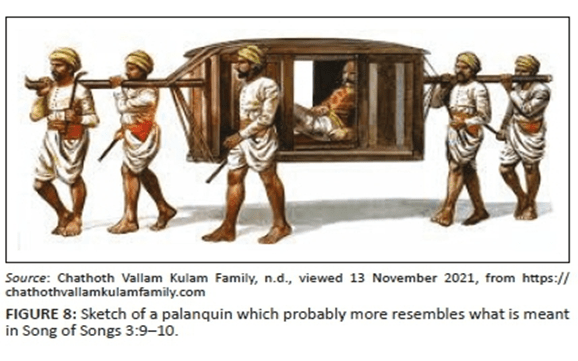
Thank you scielo.org
The girl recognises the importance of Solomon’s mode of transport with it being made out of wood from Lebanon and in verse ten includes lot of finery completed by the daughters of Jerusalem. The scene is full of drama and includes sixty body guards to protect him.
The court women are told to meet Solomon who is wearing a wedding gown and a matching well-worn crown no doubt used when marrying all his 700 wives (1 Kings 11: 3). Solomon’s mother Queen Bathsheba, who was the mistress and wife of King David, took part in all his marriages.
Who is the Maiden’s True love: Solomon or The Shepherd?
Chapter 4: 1 – 7
These verses represent a really sweet love song that may find it roots from the ‘wasf’. It is a form that has and still is used at Syrian weddings where the betrothed express their deep love for each other in images that are not literal but used to convey their tender love. The words relate to all of God’s creation and handiwork that is beautifully made and to be expressed and celebrated.
So may we listen to these loving words in a different form? The Eyes of the maiden are partly hidden by the veil she is wearing but they are described as doves eyes. Her Hair is partially uncovered and described as being like the hair of black Arabian goats!
Her Teeth look very smooth and are white just like the teeth of a shorn sheep and perfectly regular. Her Lips are bright red and thin just like a scarlet thread.
We are then told that her Cheeks remind Solomonor the Shepherd,of a well-rounded and tanned pomegranate. The maiden’s Neck is like the tower of David and covered with many shields that represent hard won trophies. Lastly her Two Breasts are likened to twin fawns in their regularity and youthful tones.
The descriptions shared by the man for the maiden, suggests that she is a perfect model and summarized in verse seven: “O my love, how beautiful you are! There is no flaw in you”!
Chapter 4: 8 – 5: 1
The tone of the Poem changes from the maiden reflecting on the majesty of Solomon and all his marriage’s. There was no expense spared and included many spices and royal robes worn and the wedding crown gifted from Bathsheba.
The Shepherd could not complete with Solomon and the maiden may have felt out of her depth with any overtones shown from Solomon. In whatever way love is found and experienced, it is always special with or without riches, or in poverty, either way it can be described in glowing and beautiful ways.
Individual love and marriage cannot be compared to any materialistic value. Marriage is about love, commitment and faithfulness.
In these verses tender words can equate to acts of physical love. They show themselves prior to marriage and then fully express themselves during the wedding, honeymoon and subsequent living and loving together. All these words represent a time of being single and then married. In being together they are likened to honey and milk as in a Promised Land and a relationship of pure love.
In verse eight; the lover says to the woman “come with me from Lebanon, my bride” and are similar words found in Chapter 2: 10 “come away” with me. The maiden has captivated and ravished the heart of the admirer and given him courage, with a look of appreciation from the girl’s eyes, that are likened to a jewel in her necklace.
The admirer, in verse ten, proclaims “how delightful is your love, my sister, my bride! How much more pleasing is your love than wine and the fragrance of your perfume than any spice”. He continues and declares that her lips drop honey as the honeycomb and the odour and fragrance of her garments and presence are like the aroma of Lebanon.

Thank you Lawrence unsplash.com
The verses continue to offer a very special description of what true love, one for another, may be like. In verse twelve it is compared to an enclosed garden with its spring shut up and a fountain sealed. A couple’s love is not for sharing and is to be protected and cherished.
Our individual gardens are to be exclusive for the one’s we love. Interestingly a locked garden compares greatly to more modern relationships that can be unopened and exposed so easily. Marriage is an exclusive bond both in the heart, mind and body.
So the maiden is compared to a cherished garden (verses 13 – 15) and beautifully laid out. Her shoots are like an orchard full of precious fruits and the trees full of spices. She is like a fountain in a garden that overflows with living waters from Lebanon.
In verse sixteen the maiden replies with a passionate invitation to her admirer to come and take possession of the garden and make it fully his own. “Let my beloved come into His garden and taste its choice fruits”.
Chapter 5: 1
The maiden as a garden, prays that the cold north wind and the soft south wind blows upon her garden and all in it are blessed in enjoying the choicest of fruits. The verse is full of excitement wherein (I think) the Shepherd accepts the invite and enters the garden and they are reunited in their beautiful and special love.
Takeaway
One of the lessons we may glean from this very expressive Poem is that both in human and spiritual relationships, we should not let the activities and responsibilities of life undermine expressions of love in all its fullness,
Each one of us seeks and requires love and tender words of appreciation and affirmation, both as a single or as a married person and within a wider family and community setting.
As a metaphor all the Poems represent God’s covenant love. Christ is the bridegroom and Israel and the Church as the bride. The common theme throughout the Poems is one of love being sought, found, lost and reunited.
What joy there will be when the church celebrates its union with Christ, as represented in the celebration of the Lord’s Supper? It is also a reflection of an open and closed garden for all to enjoy, in repentance and faith in Jesus Christ our Saviour and Lord.
Selah: (Pause to think calmly on what has just been read) and check out A Time to Worship and Motivational Moments
Graham
 Explore to Inspire