
I would like to introduce to you E who wants to remain anonymous for personal reasons. In discussions with E it became clear that due to personal experiences the question for us to consider is very close to his heart and life experiences.
Every question is very important to consider and seek out an answer and explanation in respect to it. However, it seems that some questions are very large and relate to every succeeding generations. So the question E is asking is:
“What moral dilemmas arise in the context of war, particularly in the case of the Russia-Ukraine conflict? How should Christians assess actions taken in such situations? Can violence ever be seen as a form of justice”?
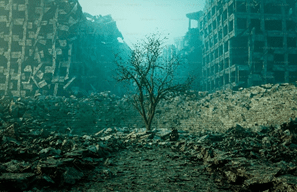
A Tree of Hope in the midst of Human Conflict Thanks Alex unsplash.com
Rev Graham replies:
The question E has asked is in relation to world-wide wars and international efforts to establish and maintain world peace. It is not simply a moral question but it is one that relates to philosophical thinking and societal planning.
It also relates to any theological concept of a creator and sustaining God, expressed in the lives of believers and nonbelievers. A further perennial question here is: ‘If God is a sovereign God, why does evil and conflict exist as so often expressed in wars, at the expense of that elusive peace’.
Your question E is also a political question in that there always has and will continue to be, outbreaks of localised wars and those that have become world-wide wars. There are many opinions in regards to a justification of wars that might be deemed just or unjust as is the case of the Russian – Ukrainian war at the present time. Conflict is part of the human make up and experience and we can fight against ourselves, families, neighbours and communities.
We may be resistant to any concept of a fully loving God to all peoples and any ability for God to maintain world peace. We may have a simple, yet sure, trust that a creator and sovereign God has and does sustain the world order since the first act of violence that took place in the book of Genesis 4: 8-15 where Cain, in a jealous rage kills his brother Abel.
Personally and in the world-wide church there is the belief that God is still at work in all present day situations and will continue to do so until the end of any earthly order. He will also be involved in the ushering in of God’s new kingdom to come on earth as it is and has been in heaven.
In respect to your question E, I am going to refer to a book by Andrew Ollerton God’s Book (Hodder and Stoughton) that has an honest look at one of the toughest topics ‘Conquest – Does God condone warfare and violence’.
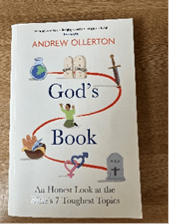
The Bible is a very realistic book that has its fair share of murder, violence and death. However, it does have some sections of calm and peace. In the New Testament we are told ‘God is Love’ (1 John 4: 8). In the Old Testament God instructs various leaders to attack and destroy the ‘enemy’. We ask the question as to how can that be?
The topic of God and warfare is very hard to understand and there are hundreds of Old Testament passages related to the use of force as commanded by God. Around one third of the Psalms also refer to warfare. More menacingly the Bible is often used as a basis to justify any warfare right up to the present day that can include world leaders Presidents Putin, Zelensky and Trump. It seems that many examples in the Bible are weaponised and justified for the benefit of those engaging in warfare and injustice.
For many people in the world God is seen as sovereign and on that basis he can do what he pleases and therefore it is an end to the discussion concerning justice and injustice, suffering and peace. However, if God is sovereign he can also activate love and peace over any existing conflicts. So E there is no easy answer to the problem of war from a Biblical point of view. It seems the case that we have to wrestle with it, particularly when it becomes situational and personal.
Many people ignore the teachings of the Old Testament and just follow the teachings of Jesus. Yet throughout the Bible, world and church history, conflict has existed and continues to exist in one form or another. To simplify the discussion, we are in danger of avoidance tactics, so for a moment may we look at violence in the Bible.
In Genesis Chapters 1 – 2 and towards the end of the Bible from Revelation Chapter 21, there is a sense of peace and harmony. However, in the rest and middle of the Bible we find that is where all the references to warfare come from. In the main there are three forms of violence that might be helpful to consider at this point.
Gratuitous Violence
What happens in the Bible is not necessarily what the Bible teaches or what God ordained to happen. The will of people seeking power and influence often dictates to certain human situations. Philosophers may teach us that life situations are a result of a: is-ought.’ It is a fallacy to think that just because it ‘is,’ means it, ‘ought’ to be! Many Bible stories are simple yet also sophisticated and dramatic in recalling human conflicts that may not be condoned or even condemned by God.
In the midst of all human situations, God can and does reveal his character and the arc of conflicts from a human perspective will always fail and fade out in time. The arc from God’s perspective is one of enabling his people and the church, in such situations, to lean towards peace and reconciliation that may not be fully appreciated in any short and dramatic conflicts.
Emotional Violence
If our anger becomes uncontrollable, it will lead to problems we may not be able to fully contain and bring to an acceptable end.
Within the Psalms of Lament we read how individuals bring to the Lord and each other their frustrations, concerns and anxieties. There is a deep desire to resolve conflicts that may include acts of warfare and peace. Such actions may for those of faith, produce greater trust, hope and a sense of thanksgiving to God, who is seen to be at work in such situations.
Real stories in the Bible help us to bring our real life situations to God and in so doing helps us to seek and find a personal peace and healing.
Holy War
This is the difficult one to understand. God often has and we assume may still do in modern times, command his people to go forth and conquer, just as Joshua did in the land of Canaan, with the outcomes of death and destruction. Such commands and actions represents a ‘holy’, or in the eyes of faith, a ‘justified war’.
There is an association that whoever your God/god may be, then such a God/god would guarantee success over failure that represented a lesser God/god. Within worldwide societies there are different forms of leadership that will dictate to how they enter into war and maintain warfare, peace and harmony for all the residents within their nations.
In a Theocracy conflict and peace exists in the context of the will of the God/god they follow. Any violence will be underpinned and governed by their God/god.
When trying to explain a ‘just war’ within a secular society, any military action is justified on the basis that the conflict has to be won so as to maintain a future peace and harmony. Winning the war prevents any expansion of evil over good.
In the Second World War allies formed together to hold back the advances of Hitler and the Nazis. The further problem is how morality is attributed to any concept of a ‘holy war’ within or outside the parameters of the Bible.
Within Christian societies Jesus has establishes a model that brings in a new ethic, in regards to the treatment of one’s enemy. Within Matthew 5: 38 -39 we have the reference to eyes and cheeks that represents revenge and a turning away from violence towards peace and forgiveness.
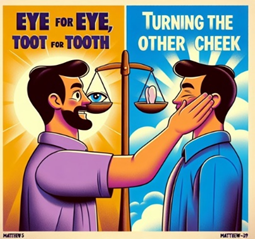
Thank you bible.art
Take Away
In the main E, Christians will always take issue in one form or another against any actions of unjust violence. Also it applies to actions that are from one person to another as in the Old Testament because of the different teachings of Jesus as found in the New Testament. Sadly in our fallen world violence and warfare are a fact of everyday living as in all the current local and international conflicts that seem very personal or impersonal. The good news for the world everywhere is that Jesus paid the price for our sin and wrong doing, which enables an unforgiving and violent humanity to also be forgiving.
In Matthew 16: 13-20 Jesus tells Peter that he is to be like a rock upon which the church on the earth will be built upon and “the gates of Hades/Hell will not overcome it”. Such words from Jesus means that when we face wars and persecution, as a result of the ministry of Jesus, we as the church can overcome sin, death and the works of the evil ones.
As throughout all generations where individuals and the church have faced conflict and violence it has and will continue to endure. As individual believers within the world-wide church we have a spiritual authority, as outlined in verse 19, that in: “whatever you bind (and loose) on earth will be bound (and loosed) in heaven”.
The Apostle Paul exhorts us all in 1 Timothy 2: 1-2 to pray “for kings and all those in authority, that we may live peaceful and quiet lives in all godliness and holiness”.
Such a radical teaching from Jesus and instructions from Paul will hopefully E, give you further insights to help you and all societies to maintain an element of peace and equality, diversity and human love and joy to God, in the midst of any confusion and injustice, that can and does extend to all we live with both near and far.
Selah: (Pause to think calmly on what has just been read) and check out A Time to Worship and Motivational Moments
Check out previous Question and Answers on similar themes:
1) How can God forgive Terrorists? 2) Is it better to forgive or retain the transgressions of people


