
Within this Insight I want to look at how trees in the Bible develop from seeds, then grow into young saplings and over many years develop into mature and mighty trees in different forms and for various purposes. In looking at physical trees we find that there is an application as to how we may find spiritual faith, grow in faith and mature in that faith with love and service to the Lord and all we live with.
In my research I came across an interesting Bible Study by Sharon Hazel from her website limitless-horizon. Please check it out as she is very happy for us to use it and I have used some of her study within this Insight and record a sincere thank you to Sharon. These are her introductory words from her study ‘20 Trees in the Bible and their Symbolism’

‘From Genesis to Revelation trees in the Bible often carry symbolic meanings. Scripture makes it clear that God speaks to humanity through His creation. Therefore, what we see and understand in the natural world can reveal deeper spiritual truths. When we reflect on the symbolism of the trees mentioned in the Bible, it brings a greater understanding of the message in the text’.
Within the Old Testament we find that the use of some trees have been connected to pagan worship in the form of Asherah whereby images have been craved onto trees and subsequently worshipped. There has also been the case that certain poles have been erected at outdoor camps and a living tree has been honoured as sacred and used in acts of pagan worship.
There are also instances where the Israelites had followed pagan practices such as Asherot (Moon Goddess) that was in opposition to instructions given under the laws of Moses and the Ten Commandments. However, there has always been times of renewal and a returning back to God as shown in the life of that godly king Hezekiah who outlawed such religious acts during his period of spiritual renewal as found in 2 Kings 18: 4-8.
The Power Within a Seed
In the creation story, as found in Genesis 1: 11–12, we read that “the earth brought forth vegetation, plants yielding seed according to their own kind and trees bearing fruit in which was their seed, each according to its kind. God saw that it was good and he approved it”. It goes without saying that any plant or tree starts its life from a tiny seed. A gardener may be presumptuous to believe that having planted a seed, which grows into its intentioned plant or tree, that somehow it is a direct result of their own skill and care!
Yes it is important for a gardener to feed, water and care for the seeds and plants but they do not have any power over a seed, for that belongs to creator God who enables the seed to fulfil its God given purpose. As humans we grow as a result of the seed and fertilisation from our parents. Then we grow physically, emotionally and spiritually depending to a great extent on how we are nurtured and develop personally.
Within scripture a seed represents a sign of God’s covenant love and promises to His people Israel. We read in Genesis 22: 17-18 a promise of God to Abraham: “I will surely bless you and make your descendants as numerous as the stars in the sky and as the sand on the seashore.” The seed in this context represents the offspring of Abraham and the fulfilment of God’s promise to him.
The Growth and Development of a Sapling
A seed may grow into a tender shoot and under the care of the grower may emerge into a sapling. There are a number of transitions in the life of a sapling that ranges from a tender sprout, to one that is established and able to withstand the rigours of all that nature will throw at it and eventually become mature within its given habitat. This period can be likened to the transition from early childhood, into youth and then on to the early stages of adult life in human form.
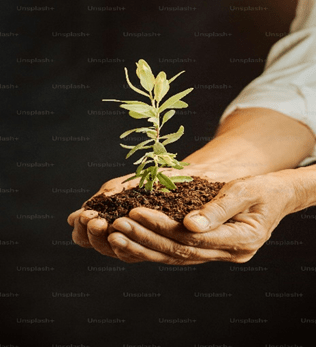
Thank you A.C. unsplash.com
In the Bible there are images that reflect the early stages of growth that lead into periods of maturity and development. Trees and plants can be used as metaphors for spiritual growth and how Christians may flourish in faith and witness. Jesus spoke about the parable of the Mustard Seed in Matthew 13: 31-32 and how a tiny mustard seed grows into one of the largest plants in a garden almost like the size of a tree. One of the aspects of the parable is that we can learn not to despise the day of small things.
In Isaiah 61: 3 the prophet refers to how “oaks of righteousness are a planting of the Lord for the display of his splendour”. In this case the mighty oak, as with other mighty trees, have begun life as a seed, then develop as saplings and grow on to full maturity as a tree. As Christians we can embrace the seed of faith and then develop as young disciples into a mature life of holiness, witness and service for the Lord.
Trees that have Matured over Hundreds of Years
At this point I want us to consider six trees found in the Bible and what they may symbolize.
The Mighty Oak
An Oak can act as a marker or signpost for certain places that represent strength and stability. It also represents long lasting faithfulness and can act as a warning against idolatry. Genesis 13: 18 (near to the Oak tree of Mamre at Hebron). Judges 6: 11 (The Oak at Ophrah). Joshua 24: 23 – 28. (A stone near an Oak tree)
The Mighty Cedar
It is valued for its use in production projects as it is strong, beautiful and stable and has a sense of the divine attached to it. It also represents a warning about any pride we may have in ourselves and our independency from God. Psalm 92:12-13. Ezekiel 31: 3-11
The Mighty Fig Tree
The fig represents peace, security and a sense of prosperity. Jesus used the fig tree in his teachings showing how we need to be ready for the Lord’s return just like when the fig is ready. Luke 13: 6-9, Mark 11: 12-14, 20 – 22.
The Mighty Acacia Tree
This tree was used in the construction of the Ark of the Covenant and symbolises the enduring nature of God in all the fulfilments of his promises to his people as represented in his covenant. Exodus 37: 1
The Mighty Olive Tree
This tree symbolises reconciliation and blessing as well as the work of the Holy Spirit. It also represents the inclusion of Gentiles into God’s family. Deut 8: 8, Psalm 52: 8, Romans 11.
The Mighty Palm Tree
It represents goodness, victory and resilience. It was used in celebrations such as the Festival of Tabernacles and Palm Sunday as found in 1 Kings 6:29, 35, 2 Chronicles 3: 5, John 12: 12-19.
Take Away
In life trees have a very important and valuable place for both natural and human environments. During Old Testament wars, it was advised not to destroy fruit bearing trees that could be used in victory but none fruit bearing trees could be cut and used for building and construction as found in Deuteronomy 20: 19–20.
When we think of the God given power within any seed the words of the Apostle Paul in 1 Corinthians 15: 36-38 come to mind: “What you sow does not come to life unless it dies. And what you sow is not the body that will be, but a bare seed, perhaps of wheat or something else.”
This metaphor illustrates how a seed must die so as to bring forth new life contained within it. It also applies to how we must die to self and live for Christ and how one day we will die physically and enter into that resurrected new life and body through Jesus Christ our Saviour and Redeemer.
In Job 14: 7-9 we read: “For there is hope for a tree: If it is cut down, it will sprout again, and its tender shoots (like a sapling) will not fail. If its roots grow old in the ground and its stump dies in the soil, at the scent of water it will bud and put forth twigs like a sapling.” These verses reflect the enduring hope and potential for renewal in new seeds, saplings and young trees even when circumstances seem dire and hopeless.
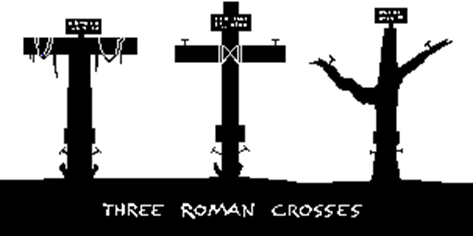
High tau cross. Low tau cross. Single tree or living tree
In this Insight it has intrigued me as to what tree, the cross Jesus was crucified on came from? There is a Christian tradition in some circles but not found in scripture that it was from the Dogwood tree! Jesus both blessed and cursed the tree so that it would never again grow to such a length for future use in crucifixions.
In reality we are not sure what type of tree Jesus was crucified on but it seems, from various archaeological data, that Roman crucifixions used whatever timber was at hand locally and that would include olive, cypress, pine, or even cedar!
As individuals in one form or another we will have had sown over us seeds of love, faith and hope that have germinated and grown as a sapling and matured into mighty men or womean of faith, worship and witness.
Yes there will have been many seeds of discord, unloving actions and consequences that affected our life as a sapling and remain, even as a mature tree. In both cases as we die to self we can be renewed daily by the power of the resurrected Jesus and the infilling of the Holy Spirit that maintains our hope and purpose in life. Then as mighty men and women of faith we sow seeds of God’s love in prayer and loving acts of service to all we met and live with.
Finally, may we remember that well know phrase: “mighty oaks from little acorns grow”. It teaches us that from humble and secret beginnings we may patiently and steadily start a life of faith, a project to complete, a family to care for and that will in its own way lead to impressive growth and maturity just like that simply seed that grows into a strong tree and stands tall for many years to come.
Selah: (Pause to think calmly on what has just been read) and check out A Time to Worship and Motivational Moments
Graham

